By Lisa Crawford March 9, 2026
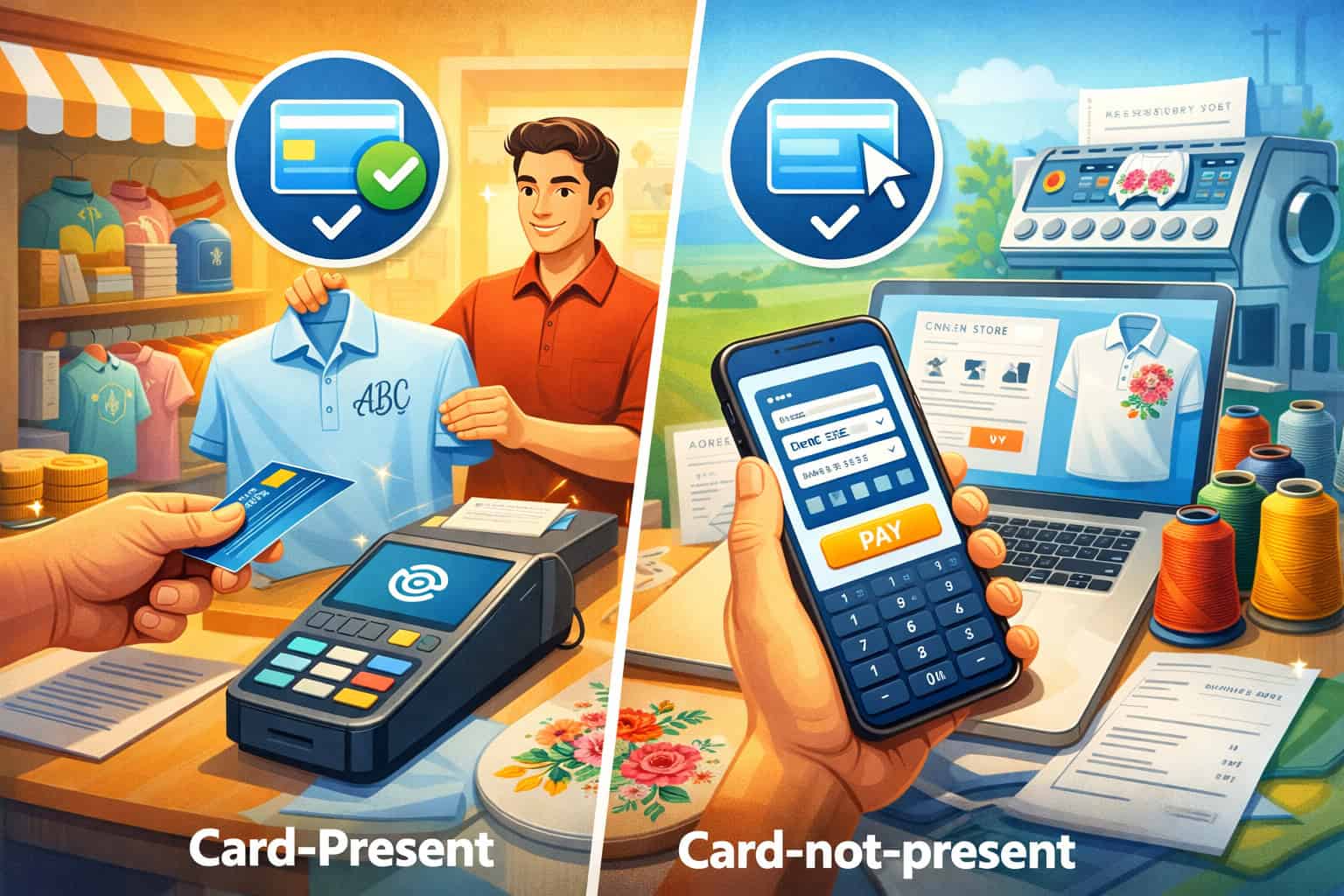
For embroidery businesses, getting paid is not just a back-office task. It affects cash flow, customer experience, production timing, risk, and even whether an order runs smoothly from approval to pickup or shipping. That is why understanding card-present vs card-not-present payments for embroidery matters so much.
Embroidery shops rarely operate through a single sales channel. One customer may walk in and tap a card at the counter for a few monogrammed hats. Another may approve a bulk uniform order by email and pay through an invoice link.
A school booster club may call in a reorder. A corporate buyer may want deposits upfront, a final payment before release, and stored billing details for future jobs. These are very different payment moments, and they do not all carry the same costs, risks, or operational challenges.
The good news is that you do not need to choose one payment type forever and ignore the other. Most embroidery businesses benefit from using both. The real goal is to know when each method makes sense, what tools support it best, and how to build workflows that protect your margins without frustrating customers.
In this guide, you will learn what card-present and card-not-present payments mean, how they apply to embroidery and custom apparel businesses, why pricing and fraud risk differ, and how to create a payment setup that supports retail sales, custom orders, online stores, pop-up events, repeat clients, and growing multi-channel operations.
You will also see practical ways to reduce payment risk, improve approvals, and make payment processing for embroidery businesses more reliable at every stage of the order lifecycle.
What Card-Present and Card-Not-Present Payments Mean in an Embroidery Business
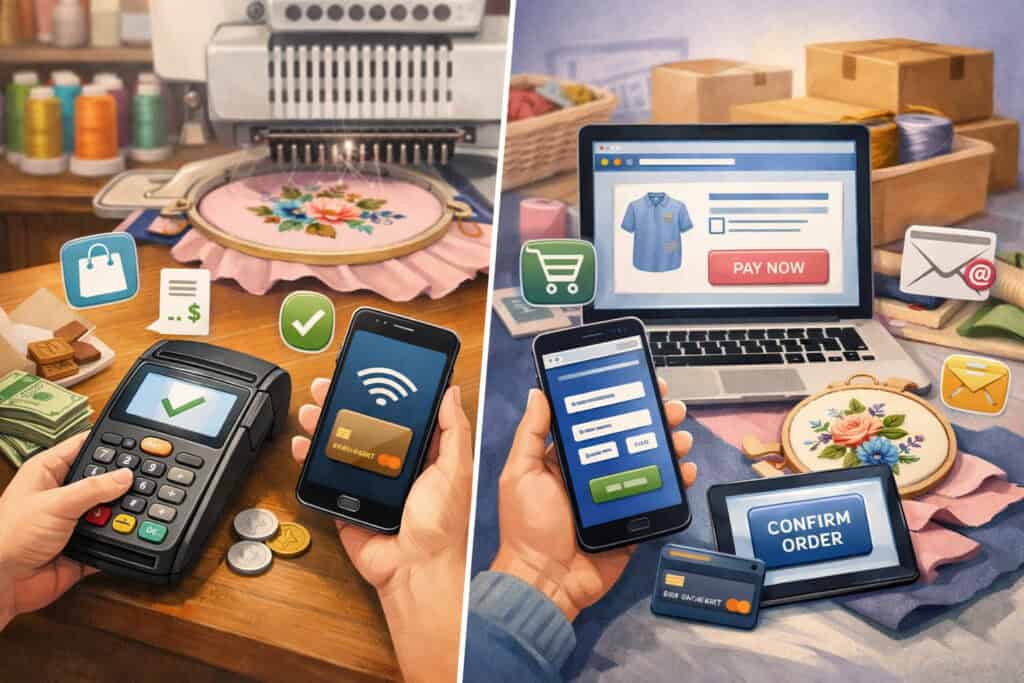
At the most basic level, a card-present transaction happens when the customer’s card is physically used in person during the sale.
In an embroidery shop, that usually means the customer inserts a chip card, taps a contactless card or mobile wallet, or swipes a magnetic stripe at a payment terminal. The payment data is captured directly from the card at the point of sale.
A card-not-present transaction happens when the card is not physically at the time of payment. That includes online checkout, invoice payments, payment links, virtual terminal entries, phone orders, and manually keyed-in transactions. In these cases, the business accepts card information remotely rather than through a face-to-face checkout terminal.
This distinction matters because payment providers and card networks generally view in-person card use as lower risk than remote transactions. When the card is present and the terminal reads the card data securely, there are more safeguards in place to confirm that the card is legitimate.
When the card is not present, there is more uncertainty. The transaction may still be perfectly valid, but it can be easier for stolen card details to be used without the true cardholder being there.
For embroidery businesses, that difference shows up in several important ways:
- Processing costs can differ
- Fraud and chargeback exposure can differ
- The payment tools required can differ
- Your internal workflows can differ
- The customer experience can differ
That is why card-present payments for embroidery shops and card-not-present payments for embroidery businesses should not be treated as interchangeable. They solve different operational needs.
What counts as a card-present payment for embroidery shops
In-person card payments for embroidery shops usually happen when a customer pays face to face using a countertop terminal, mobile card reader, or integrated point-of-sale system. These transactions are common in retail storefronts, showrooms, markets, events, and pickup counters.
Examples include a customer buying blank caps with on-site stitching, paying for a rush monogram pickup, or settling the balance on a custom jacket order when they arrive to collect it. If the customer taps a card or mobile wallet at your terminal, that is generally a card-present payment.
EMV chip acceptance and contactless tap-to-pay are especially important here. They help confirm that the payment credential is being read securely by the device instead of being manually entered. For an embroidery shop, that can mean better protection on everyday counter sales.
What counts as a card-not-present payment for embroidery businesses
Card-not-present transactions for embroidery stores include any remote sale where the card is not physically used at your terminal. This often includes online stores, payment links sent by text or email, virtual terminal sales, phone authorizations, and invoices paid through a hosted payment page.
Examples include a customer paying a deposit for a team apparel order through an emailed invoice, a business client paying from an accounts payable portal, or a shopper purchasing embroidered polos through your eCommerce site. Keyed-in payments for embroidery orders also fall into this category, even if the customer is speaking with you live over the phone.
Because embroidery businesses often handle custom orders, approvals, reorders, and shipped jobs, card-not-present acceptance is usually not optional. It is often necessary for convenience and growth. The key is understanding how to use it carefully.
Why the Distinction Matters for Embroidery Businesses
Embroidery is not a simple one-step retail model. Many businesses in this space combine showroom traffic, repeat wholesale-style accounts, event selling, and remote custom order fulfillment. Because of that, the difference between card-present and card-not-present payments has real consequences for both revenue and operations.
A standard retail store might ring up mostly immediate, in-person sales. An embroidery business often does far more than that. You may collect a design approval deposit today, order garments tomorrow, finish production next week, and release the order only after a final invoice is paid.
In another case, you may run an online storefront for school spirit wear while also taking walk-in monogram jobs at the counter. These sales channels do not behave the same way from a payment perspective.
The distinction matters first because of timing. Embroidery work is frequently tied to custom production. That means the payment method you choose affects whether you can confidently begin work, purchase materials, schedule machine time, or release finished products. A reliable payment process helps prevent situations where labor begins before funds are secured.
It also matters because of dispute risk. Custom orders can create misunderstandings if a buyer later claims the order was not authorized, not delivered, or not as expected. Card-not-present transactions may be more exposed if documentation is weak.
For example, if you take a phone payment for embroidered uniforms without written approval of the artwork, quantities, sizes, and turnaround, you may have a harder time defending a future chargeback.
There is also a customer expectation issue. Buyers want convenience. Some want to tap a card at pickup. Others want an online checkout link they can forward to a team manager or bookkeeper. If you only support one style of payment, you may lose orders or create unnecessary delays.
Custom orders make payment timing more important
In embroidery, payment is closely tied to order stages. Many businesses require a deposit before digitizing, sourcing garments, or reserving production capacity. Others require full payment before production starts, especially for first-time buyers or highly personalized work. Still others split payment into deposit and balance due at pickup or before shipping.
These decisions are easier to enforce when you understand which payment type fits each stage. A card-present payment may be ideal when the buyer picks up the finished job. A card-not-present payment may be necessary when the customer approves the estimate remotely and wants the order started right away.
That makes custom order payment processing more than a technical issue. It becomes part of your production control system. A good payment setup helps you avoid chasing deposits, delaying jobs, or handing over merchandise before the balance clears.
Multi-channel sales create different risk and cost profiles
Many embroidery businesses now sell through multiple channels at once. You may have:
- A storefront or showroom
- Pop-up event or market sales
- An online order form or eCommerce site
- Phone or email order intake
- Recurring client reorders
- Invoice billing for schools, teams, clubs, or businesses
Every channel has different convenience needs and different payment risk for embroidery businesses. In-person sales may feel faster and more secure. Online and invoice payments may expand your reach and simplify remote ordering, but they often come with higher costs and higher chargeback exposure.
This is why payment processing for embroidery businesses should be evaluated by business model, not just by rate quotes.
The right answer for a retail-heavy monogram shop may differ from the right answer for a home-based seller shipping custom apparel nationwide, or a growing operation handling repeat decorated uniform orders for multiple organizations.
How Embroidery Shops Use Card-Present Payments

Card-present transactions remain extremely valuable for embroidery shops, especially when the sale happens face to face. They are often the most efficient fit for immediate purchases, walk-in traffic, pickup payments, and event-based selling. When set up properly, they also tend to offer a smoother experience for customers who expect quick checkout.
For a storefront embroidery business, card-present payments may be the foundation of day-to-day sales. A customer comes in to browse samples, discusses thread colors or placement, confirms the order, and pays at the counter.
If they are buying ready-to-sell embroidered items or placing a simple custom request, using a chip reader or tap-enabled terminal gives both speed and confidence.
These transactions are also helpful when customers pick up completed orders. Many embroidery businesses collect a deposit in advance and then the final balance when the job is ready.
A card-present terminal at pickup allows the customer to review the finished work, ask questions, and complete payment on the spot. That can reduce payment delays and help move orders out the door faster.
Another strong use case is mobile selling. Pop-up events, trade shows, school functions, craft fairs, and local vendor markets can all be good opportunities for in-person card payments for embroidery shops. A mobile reader connected to a phone or tablet can let you accept tap, chip, or swipe payments without sending people elsewhere.
Best-fit situations for card-present transactions for custom apparel shops
Card-present transactions for custom apparel shops usually make the most sense when the buyer and seller are physically together and the order decision is final at that moment. These are often the lowest-friction situations for both sides.
Common examples include:
- Walk-in retail purchases
- Counter sales of stock embroidered goods
- Paying the remaining balance at pickup
- On-site personalization at events
- Trade show or market transactions
- Reorders placed and paid in person by local clients
Because the customer is present, the checkout experience is straightforward. They can insert a chip card, tap to pay, or use a mobile wallet. The payment is processed immediately, and you can provide a receipt right away. For many small shops, this reduces administrative work compared with sending invoices or following up on links later.
There is also a practical trust benefit. Face-to-face payments tend to feel more concrete to both parties. The customer sees the shop, the merchandise, and the person taking payment. The business sees the customer complete the transaction in person. That does not eliminate disputes, but it can reduce confusion compared with purely remote ordering.
Why EMV and tap-to-pay matter for embroidery storefronts
EMV chip acceptance and contactless payments are not just modern conveniences. They can support better security and a cleaner checkout experience. When a card is dipped or tapped instead of manually entered, the terminal is reading the card credential directly in a more controlled way.
For embroidery businesses, this matters because many orders involve custom work. If there is ever a later question about authorization, using a secure in-person acceptance method can be helpful. It also speeds up busy periods, especially during pickup rushes, holiday monogram seasons, or event selling.
Tap-to-pay also helps with customer expectations. People increasingly want quick checkout without passing cards back and forth. A terminal that supports tap from cards and mobile wallets can make the business feel more current and efficient.
How Embroidery Businesses Use Card-Not-Present Payments
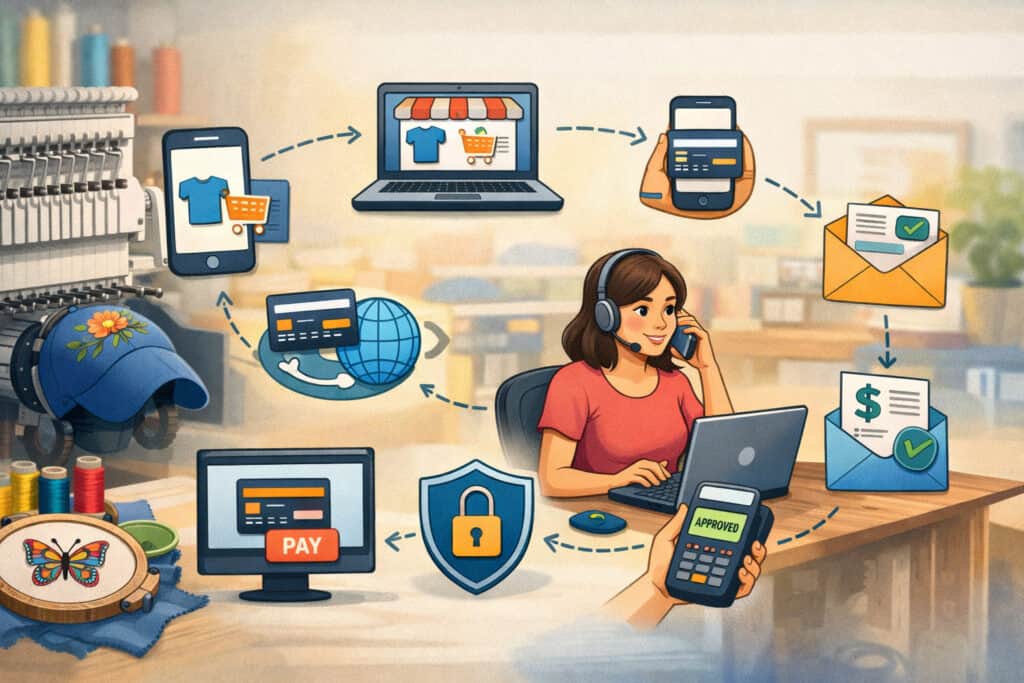
Card-not-present acceptance is often what makes embroidery businesses more flexible and scalable. It allows you to take deposits before the customer visits, close orders remotely, accept online sales around the clock, and serve clients who never come to your shop in person. For many businesses, it is essential rather than optional.
This is especially true in custom apparel work, where the sales process often begins before any finished item exists. A client may request a quote by email, approve a mockup remotely, and need to pay a deposit before production begins.
In that scenario, an in-person terminal does not help. You need a way to accept remote payments securely and efficiently.
Online card payments for embroidery businesses also support broader selling strategies. You might run an eCommerce site for embroidered polos, patches, uniforms, or gift items.
You might use invoice links for business buyers or team organizers. You might take rush orders by phone and key them into a virtual terminal when the buyer needs a quick turnaround.
The challenge is that card-not-present transactions usually cost more and carry more fraud and chargeback exposure. That does not mean you should avoid them. It means you should use the right tools and set up stronger supporting processes around order documentation, shipping confirmation, and customer approvals.
Common card-not-present transactions for embroidery stores
Card-not-present transactions for embroidery stores can take several forms, depending on how orders come in and how customers prefer to pay. Some of the most common include online checkout, invoice payments, and manually entered payments through a virtual terminal.
You may see these situations often:
- A customer pays a deposit through an invoice emailed after quote approval
- A buyer completes an order through your online store
- A corporate client pays from a payment link sent by your office
- A returning customer calls to reorder staff shirts and provides card details by phone
- A home-based embroidery business collects full payment remotely before shipping
- A team organizer pays for sample approval or digitizing before the bulk order is scheduled
These methods are convenient because they let business move forward without requiring a physical visit. That can shorten the sales cycle, improve responsiveness, and make it easier to work with remote customers or busy account buyers.
At the same time, you should not treat all remote payment methods as equal. A hosted online checkout with billing checks and confirmation emails may be safer and more organized than a loosely documented phone payment. The structure around the transaction matters.
Tools that support remote payment processing for embroidery businesses
A modern remote setup often includes more than one tool. eCommerce payment processing for embroidery shops may cover website checkout, while invoicing software handles custom estimates and balance collection.
A virtual terminal can support special cases, such as phone orders or manually entered business account payments.
Useful card-not-present tools often include:
- Online checkout pages
- Emailed or texted payment links
- Invoicing tools with embedded payment options
- Virtual terminals for keyed-in payments
- Customer vaults or stored payment credentials for repeat billing
- Order management systems connected to payment records
Stored payment credentials can be helpful for repeat business accounts that place recurring orders. For example, a company that regularly orders embroidered workwear may want a card securely kept on file for approved reorders.
That can reduce back-and-forth and speed up production scheduling. Still, businesses should use proper authorization practices and make sure customers understand how future charges will be handled.
Key Differences in Fees, Fraud Risk, and Operations
The biggest practical differences between card-present and card-not-present acceptance usually come down to cost, fraud exposure, and administrative complexity. These differences are especially important in embroidery, where margins can already be affected by blanks, labor, setup time, rush schedules, and remake risk.
Card-present payments are often priced more favorably because they are seen as lower risk. The customer is physically present, and the terminal reads the card data directly through a chip or contactless interaction.
That does not guarantee every transaction is safe, but it gives the payment ecosystem more confidence that the card is genuine and being used by the rightful holder.
Card-not-present transactions often cost more because there is less certainty. The card may be valid, and the order may be legitimate, but the seller is relying on remotely submitted data.
Since the business is not seeing the card used in person, the chance of stolen credentials or disputed authorization is generally higher. This added risk often results in higher processing expenses.
Operationally, remote acceptance can also require more follow-up. You may need to verify billing details, review orders more closely, document approvals, confirm shipping addresses, and maintain better records to defend against disputes.
For embroidery businesses, that is especially relevant when the order involves customized goods that cannot be resold easily.
Why card-not-present payments often cost more
There is no single universal price for every merchant account, provider, or transaction type, but the general pattern is consistent: card-not-present transactions are often more expensive than card-present ones. That is because remote payments are usually considered riskier by the payments ecosystem.
For embroidery businesses, this means online card payments for embroidery businesses, invoice-based payments, and virtual terminal entries may carry higher effective acceptance costs than chip or tap transactions at the counter. If a large share of your business is online or remote, that cost difference can materially affect margins.
Several factors influence this:
- The absence of the physical card
- Higher fraud exposure
- Higher chargeback risk
- Manual entry risk on keyed-in payments
- Potential mismatch between billing, shipping, and customer identity
- Increased documentation burden for dispute defense
This does not mean remote payments are bad for business. They may still be the best option for convenience, speed, and growth. It simply means your pricing and workflow decisions should account for them.
For example, a shop doing complex custom apparel jobs may decide to require larger deposits upfront or use approval checkpoints to reduce the chance of expensive disputes later.
How fraud and chargeback risk differ in embroidery payment workflows
Fraud risk and chargebacks do not affect every embroidery business equally, but the risk increases when the order is remote, customized, rushed, or shipped without strong documentation.
In many cases, the problem is not criminal fraud alone. It may also involve misunderstandings, poor order records, or customers forgetting what they approved.
Card-present sales can still be disputed, but a transaction completed with EMV or tap at pickup often has a cleaner trail of authorization. Card-not-present transactions may require stronger supporting proof, especially if the goods are personalized and cannot be returned in standard retail condition.
For embroidery businesses, common risk points include:
- Starting production before collecting a valid deposit
- Accepting large keyed-in payments without written approval
- Shipping to an address that differs from the order record
- Failing to document artwork approval or spelling confirmation
- Not retaining proof of delivery
- Storing card data improperly outside approved systems
A card-not-present payment can be perfectly appropriate, but it should be supported by better internal discipline. Order forms, approval emails, invoices, signed proofs, and shipment tracking are not separate from payments. They are part of payment risk management.
Choosing the Right Payment Mix for Your Embroidery Business
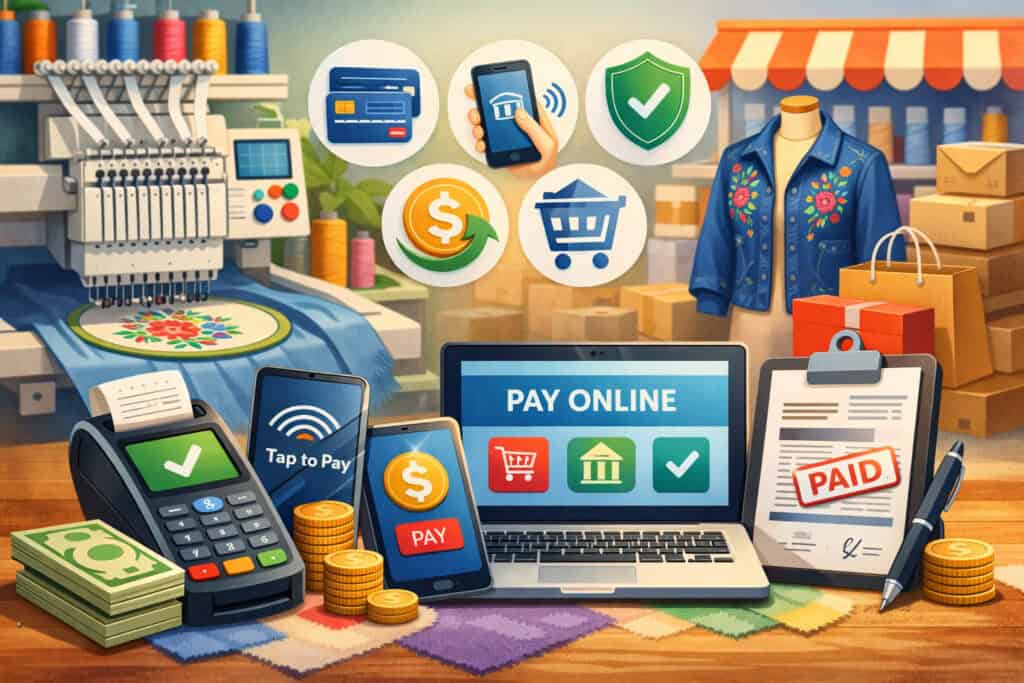
Most embroidery businesses should not think in terms of choosing card-present or card-not-present payments once and for all. A better approach is to build the right mix. The ideal setup depends on how you sell, when you collect money, what kinds of customers you serve, and how much customization is involved in each job.
A walk-in shop with local pickup may lean heavily on card-present acceptance. An online custom apparel seller may rely mostly on card-not-present transactions.
A growing multi-channel operation might need both at the same time, along with policies that define when deposits are required, when final payment is due, and which order types can be paid remotely.
The best payment mix balances four things: convenience, cost, risk, and operational control. If you focus only on convenience, you may expose the business to avoidable disputes. If you focus only on cost, you may slow down order intake and make buying harder than it needs to be. If you focus only on risk, you may create rigid rules that frustrate loyal customers.
Instead, align the payment method with the business scenario. Small immediate purchases can be handled one way. Larger custom jobs can follow a deposit-and-balance workflow. Online storefront orders can use automated checkout. Repeat business accounts can use invoicing or approved stored payment credentials where appropriate.
Best payment setups for different embroidery business models
Different embroidery business types often need different combinations of tools and policies. A one-size-fits-all system usually leaves gaps.
A small storefront with regular walk-in traffic may benefit most from:
- A reliable countertop terminal
- Tap and chip acceptance
- POS integration for retail items
- Optional invoices for larger custom jobs
- Pickup payment capabilities
A home-based embroidery business may need:
- Invoicing tools
- Payment links
- Online checkout
- Virtual terminal access for special cases
- Clear deposit requirements before production
An online custom apparel seller may need:
- eCommerce checkout with fraud controls
- Shipping confirmation systems
- Strong order confirmation emails
- Customer communication around production timelines
- A way to capture balance payments for add-ons or changes
A growing multi-channel operation may need all of the above, plus stronger reporting and a structured embroidery merchant account setup that supports both in-person and remote acceptance under one system.
How to decide when to require deposits, full payment, or balance on pickup
Embroidery work often involves commitments before the finished order exists. You may need to buy garments, reserve machine time, digitize art, or turn away other work to hold a production slot. That is why payment timing matters as much as payment method.
Many shops use one of these models:
- Full payment upfront for smaller custom jobs
- Deposit upfront and balance before shipping or at pickup
- Approved invoicing terms for established business accounts
- Payment upon order confirmation for online personalized items
The right model depends on the complexity of the order, the customer relationship, the lead time, and how easily the finished goods could be resold. Highly customized items usually justify stronger upfront collection practices. Repeat local clients with established history may allow more flexibility.
The key is consistency. Your team should know which orders require which payment stage and which payment methods are allowed at each point. That makes operations smoother and reduces uncomfortable exceptions.
Best Practices for Managing Both Payment Types
Using both card-present and card-not-present acceptance can be a major advantage, but only if the systems around them are organized.
When businesses treat payments as isolated transactions instead of part of a broader order workflow, they often run into preventable problems such as missing deposits, unclear approvals, weak documentation, or disputes over delivery and turnaround.
The strongest payment workflows for embroidery businesses connect several moving parts: quoting, order approval, deposits, production scheduling, final billing, pickup or shipping, and record retention.
Whether the card is present or not, the goal is the same. You want the payment process to feel smooth for the customer while keeping the business protected and operationally efficient.
This begins with choosing tools that fit the way your business actually sells. A terminal alone is not enough if most of your orders begin online. A payment link alone is not enough if your pickup counter gets busy during peak seasons.
You need the ability to accept secure in-person payments while also supporting invoices, online checkout, and remote approvals where necessary.
It also means training your staff. The person taking an order should know when to send an invoice, when to collect a deposit immediately, when to request artwork approval first, and when a keyed-in transaction needs extra documentation. The fewer gray areas you leave, the better your outcomes tend to be.
Ways to reduce payment risk and improve authorization rates
Reducing payment risk does not require making the process difficult for customers. In many cases, it means adding structure and clarity. For card-not-present transactions especially, strong order records and thoughtful verification can make a real difference.
Practical ways to lower payment risk include:
- Use EMV and contactless acceptance for in-person sales whenever possible
- Avoid unnecessary keyed-in transactions when a secure link or invoice will do
- Match billing and shipping details carefully for remote orders
- Keep written approval for designs, spelling, quantities, and turnaround
- Send clear order confirmations immediately after payment
- Collect deposits before ordering materials or starting production
- Retain proof of pickup or shipment
- Use secure stored credential tools instead of keeping card details manually
Improving authorization rates also matters. Declines can delay production and frustrate customers. Make sure invoices are easy to pay from mobile devices, checkout pages are not overly confusing, and payment requests clearly identify the business and order purpose.
Customers are more likely to complete payment when the process is trusted and straightforward.
Building a smoother customer experience across in-person and online payments
The payment experience should feel connected even if the customer interacts with you in different ways over time.
A buyer might first request a quote online, approve a mockup by email, pay a deposit through a link, then come in person to pick up the order and settle the balance at the counter. That should feel like one coherent process, not four disconnected systems.
To create that smoother experience, try to keep payment records tied to order records. Use consistent invoice language. Include order numbers, customer names, and item descriptions where appropriate.
Let customers know when a deposit is nonrefundable, when a balance is due, and what happens if the order changes after approval.
This is also where communication matters. If production will not begin until payment clears, say so early. If final payment is required before shipping, make that clear in the estimate and reminder messages. A payment system feels better when customers know what to expect at each stage.
Common Mistakes to Avoid
Even businesses with strong craftsmanship and loyal customers can run into payment issues when workflows are inconsistent. In embroidery, the most common mistakes are rarely about not having a payment option at all.
They are more often about using the wrong payment method for the situation, failing to document approvals, or letting convenience override the process.
One common mistake is starting work before payment terms are satisfied. This may happen when a shop wants to be helpful, especially for a new customer with a rush timeline.
But once production begins, the business may be committed to garments, thread, setup time, and machine hours that cannot be recovered easily. If the payment later fails or the customer disputes the order, the cost can be painful.
Another mistake is relying too heavily on keyed-in payments for embroidery orders. Manual entry through a virtual terminal may be necessary sometimes, but it should not become the default when better options exist.
Hosted invoices, secure payment links, and online checkout tools often provide cleaner customer records and more structure around the sale.
A third issue is weak communication between sales and production. If the production team starts work without confirmation that the deposit has been collected and the design approved, avoidable problems follow. Payment status should be visible and meaningful inside your workflow.
Operational mistakes that increase cost and confusion
Some errors do not look serious at first, but they add friction, lost time, and unnecessary expense over time. These mistakes often show up in growing businesses that add new channels without updating their internal process.
Examples include:
- Using separate systems that do not sync order and payment status
- Letting customers pay a balance through outdated or unclear invoices
- Releasing shipped orders before the final payment is settled
- Failing to note whether an order was paid in person, online, or by invoice
- Not creating internal rules for deposits on custom jobs
- Storing customer card details outside approved payment tools
When these gaps add up, staff spend more time tracking down answers, customers get mixed messages, and disputes become harder to resolve. Stronger systems reduce chaos even more than they reduce fraud.
Customer-facing mistakes that can lead to disputes
Not every chargeback begins with bad intent. Many start with confusion. A buyer may not recognize the descriptor on their card statement. A team organizer may forget they approved a design proof. A business account may think a deposit covered the full order. These issues are preventable when communication is detailed and consistent.
Customer-facing mistakes to avoid include:
- Vague invoice descriptions
- Unclear deposit terms
- Missing production or delivery timelines
- No written approval on personalization details
- No reminder that custom goods may not be returnable in standard ways
- Surprise balance requests at pickup or before shipping
For embroidery businesses, clarity is part of trust. The better your order and payment communication, the less likely customers are to question valid charges later.
Frequently Asked Questions
Q.1: Is card-present or card-not-present better for embroidery businesses?
Answer: Neither is universally better. The right option depends on how the sale happens. Card-present payments are usually a strong fit for walk-in sales, local pickups, and event transactions because they are efficient and often lower risk.
Card-not-present payments are often necessary for remote deposits, online orders, invoice billing, and repeat account sales. Most embroidery businesses benefit from using both.
Q.2: Why do card-not-present payments usually cost more?
Answer: Card-not-present payments often cost more because the card is not physically used at the time of the transaction. That generally creates more fraud and chargeback exposure than an EMV or tap-based in-person sale.
For embroidery businesses, remote orders can still be worth the extra cost because they support online selling, faster approvals, and wider customer reach. The key is managing them carefully.
Q.3: Are keyed-in payments safe for embroidery orders?
Answer: Keyed-in payments can be legitimate, but they usually carry more risk than chip or tap transactions. They should be used thoughtfully, especially for large or highly customized orders.
If you take keyed-in payments for embroidery orders, it helps to keep strong order documentation, written approvals, and clear customer communication tied to the transaction.
Q.4: Should an embroidery shop require a deposit before production starts?
Answer: In many cases, yes. Deposits help protect the business before it spends money on blanks, setup, digitizing, or production time. They are especially useful for custom orders, bulk jobs, or work that cannot be resold easily.
The exact amount and timing depend on your business model, but the policy should match your real production risk.
Q.5: What is the best payment method for online embroidery orders?
Answer: For online embroidery orders, a secure checkout or invoice-based payment page is usually a practical choice. It allows customers to pay remotely while giving the business a cleaner record of the transaction.
Good online card payments for embroidery businesses should be paired with strong order confirmations, clear customization details, and shipping or pickup communication.
Q.6: Can embroidery businesses store customer cards for repeat orders?
Answer: They can often use stored payment credential tools provided through approved payment systems, especially for repeat business accounts or recurring buyers. That can make reorders easier and reduce delays.
However, businesses should never handle card storage casually. It should be done through secure systems with clear customer authorization and internal rules around future charges.
Q.7: What is the biggest payment risk for embroidery businesses?
Answer: One of the biggest risks is taking payment for a custom order without enough documentation around approval, fulfillment, and customer communication. Fraud matters, but disputes can also come from confusion.
When the order involves custom decoration, your best protection often includes written approvals, clear payment terms, and proof of pickup or delivery, not just the transaction itself.
Conclusion
Understanding card-present vs card-not-present payments for embroidery is ultimately about more than comparing transaction types. It is about building a payment system that fits the way your business quotes, produces, delivers, and grows.
Card-present payments for embroidery shops are often ideal for walk-in sales, local pickups, and event transactions. They support fast checkout, can reduce payment risk, and work well when the customer is physically present.
Card-not-present payments for embroidery businesses are often essential for deposits, online stores, invoice payments, phone orders, and repeat account relationships. They bring flexibility and reach, but they also require stronger process control.
The most successful embroidery businesses usually use both. They match the payment method to the order type, collect money at the right stage, document approvals carefully, and make the experience easy for the customer without losing sight of risk or margin. That is the real goal of smart payment processing for embroidery businesses.
If your shop handles custom orders, online sales, local pickups, and repeat business accounts, the right answer is not choosing one payment type over the other.
It is creating a reliable system where in-person card payments for embroidery shops and online card payments for embroidery businesses work together. When you do that well, you protect your cash flow, improve customer trust, and give your business more room to scale with confidence.