By alphacardprocess March 9, 2026
Custom apparel businesses no longer serve only local buyers. A shop that once handled school spirit wear, company polos, event T-shirts, uniforms, or branded merchandise for nearby clients can now attract buyers from far beyond its usual service area.
Social commerce, online storefronts, referral traffic, and niche demand have changed the way custom clothing businesses grow. That shift creates real opportunity, but it also raises an important question: how do you handle payment when a customer is ordering from another country?
Accepting international payments for custom apparel orders is about much more than letting a foreign card go through at checkout. It affects quoting, deposits, production timelines, design approvals, shipping coordination, final balance collection, fraud prevention, and customer trust.
A payment process that works well for domestic jobs may create friction when a buyer wants to pay in another currency, use a different payment method, or split payment across multiple project stages.
For custom apparel businesses, those details matter because custom orders are rarely simple one-click purchases. Many involve proofs, customization requests, size breakdowns, embroidery placements, print approvals, reorder discussions, or bulk order planning.
That means your payment setup has to support both convenience and control. You need a way to make buying easy for legitimate customers while protecting your margins and reducing operational headaches.
This guide explains what international payment processing means for custom apparel businesses, why it matters, which payment methods to consider, the most common challenges, and how to choose a setup that fits your sales model.
It also covers practical strategies for managing cross-border payments for custom apparel orders in a way that supports smoother operations and better customer experience.
What Accepting International Payments Means for Custom Apparel Businesses

At its core, accepting international payments for custom apparel orders means giving customers outside your home market a reliable way to pay you for personalized products and services.
That can include online orders for printed shirts, bulk uniform programs, team wear, event merchandise, promotional apparel, embroidery work, private-label apparel, and custom branded pieces. The payment may happen through your website, an invoice, a payment link, or a manually entered order process.
International payment processing for custom apparel businesses usually involves more moving parts than local transactions. A customer may want to pay in their own currency. Their bank may apply extra authentication checks.
Their preferred payment method might be different from what your current checkout supports. On your side, the funds may settle on a different timeline, and the fees may be different from what you are used to seeing on local transactions.
This is especially important in custom apparel because many orders are built around production workflows rather than instant fulfillment.
A customer may request a quote, review a mockup, approve artwork, pay a deposit, wait for production, and then pay the remaining balance before shipment. Your international payment process needs to support that journey without causing confusion or delay.
How international payments fit into the real custom order workflow
Custom clothing businesses often work through a structured order cycle. A customer might begin by asking for pricing on 250 embroidered jackets or 1,000 event T-shirts.
After that, your team may confirm garment selection, decoration method, artwork specs, imprint locations, shipping terms, and production deadlines. Payment is often tied to these stages rather than collected all at once.
That is why international payments for custom clothing businesses cannot be treated as just a website feature. They must fit your operational workflow.
For example, you may need one payment option for online retail orders and another for large custom jobs that require invoicing. You may also need to collect deposits before purchasing blank garments or scheduling production time.
A good setup supports flexibility without creating administrative burden. It should make it easy to send branded invoices, collect partial payments, note payment status inside the order record, and trigger production only when agreed payment milestones are complete.
When payment collection is aligned with your workflow, your team spends less time chasing balances and more time moving jobs through production with confidence.
The difference between standard checkout and cross-border payment workflows
A basic checkout page may be enough for simple orders with fixed products and limited customization. But cross-border payment solutions for apparel brands often need more than a standard shopping cart.
Many international customers are ordering for businesses, clubs, events, or resale programs, and they may expect formal invoices, clearer shipping terms, and the ability to review a quote before paying.
That is where a broader payment strategy becomes useful. Some custom apparel businesses use a global checkout for custom clothing orders on their website while also offering invoice-based billing for larger or more complex jobs.
Others use payment links to speed up approval and payment after a quote is confirmed. The goal is not to offer every payment option imaginable. It is to offer the right options for the kinds of orders you actually process.
Why International Payment Options Matter for Custom Apparel Orders

For many apparel businesses, adding international payment capabilities is not just about expansion. It is about removing barriers that stop serious buyers from placing orders.
When someone is ready to purchase uniforms, launch branded merchandise, reorder custom team wear, or buy event apparel in volume, they want the payment step to feel secure and straightforward. If your checkout feels unfamiliar, confusing, or restrictive, you may lose the order before production even begins.
Cross-border payments for custom apparel orders matter because custom products often require more customer commitment than standard retail goods. Buyers may need to coordinate sizing, confirm design details, gather approval from multiple stakeholders, or secure budget signoff.
By the time they reach the payment stage, any extra friction can create delay or hesitation. A poor payment experience can make even an otherwise strong offer feel risky.
Offering reliable international payment methods also shows that your business is prepared to serve global buyers professionally. That matters for customer confidence.
When someone is ordering customized merchandise from another country, they are not only judging product quality. They are also asking whether your business can handle payment, communication, timelines, and shipping in a way that feels organized and trustworthy.
Wider market reach without forcing buyers into a difficult payment process
The most obvious benefit of international payment processing for custom apparel businesses is broader reach. You can serve buyers who find you through search, marketplaces, social channels, referrals, trade relationships, or repeat business.
That may include sports teams, corporate buyers, event organizers, schools, nonprofits, creators, and distributors looking for custom merchandise or apparel programs.
But wider reach only helps if customers can actually complete the purchase. A buyer who cannot use their preferred card, sees unclear currency pricing, or worries about payment security may leave before submitting the order.
In custom apparel, that lost opportunity can be substantial because order values are often higher than standard eCommerce purchases. One abandoned bulk order may represent a meaningful amount of revenue.
By using global payment solutions for custom apparel businesses, you reduce those drop-off points. Customers can review pricing clearly, choose familiar payment methods, and complete transactions with fewer questions. That creates a smoother buying path and makes it easier to convert serious inquiries into paid orders.
Better trust and conversion for custom orders with longer sales cycles
Trust plays a major role in international payments for custom clothing businesses. Buyers are often paying for goods that have not been produced yet. They may be sending logo files, approving mockups, and paying before shipment. That naturally creates caution, especially when the seller is located elsewhere and the order is customized.
A secure, professional payment experience helps reduce that concern. Branded invoices, recognizable payment pages, support for common payment methods, and clear payment terms all make your business feel more established.
Customers want to know what they are paying, when they are paying it, what happens next, and how their information is protected. This trust factor can directly support conversion. A buyer who feels comfortable paying the deposit is more likely to move forward quickly.
A finance team that receives a proper invoice is more likely to approve a bulk order without back-and-forth. A smoother payment process helps your sales cycle move from quote to production with fewer delays.
Easier collection for overseas buyers with different preferences
Not every customer wants to pay the same way. Some prefer international credit and debit cards. Others want a digital wallet, bank transfer, or invoice payment option.
Some buyers are comfortable checking out online, while others expect a payment request they can share internally for approval. In cross-border transactions, these differences become more important.
Foreign customer payment methods for apparel businesses can vary based on buyer habits, order size, and the way their organization manages purchasing. That does not mean you need dozens of options. It means you should understand which methods matter most for your business model.
For online stores, a strong multi-currency checkout and digital wallet support may do most of the work. For high-value B2B orders, invoicing and bank transfer support may be more useful.
Common Payment Methods for International Custom Apparel Transactions
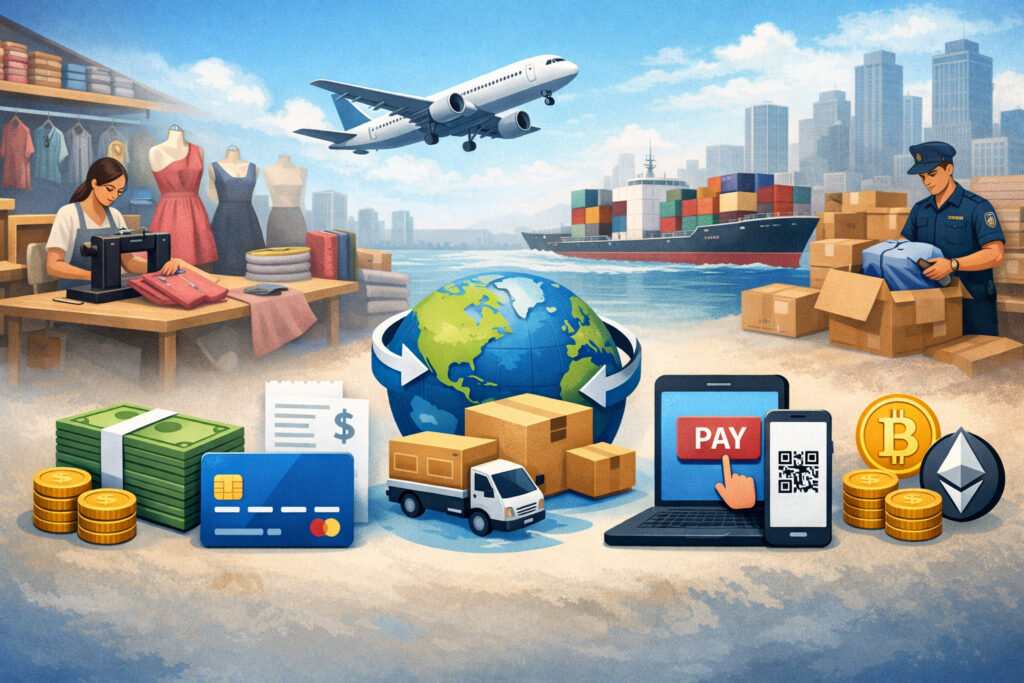
There is no single best payment method for every custom apparel business. The right mix depends on what you sell, how you sell it, and who your buyers are.
A shop focused on online direct-to-consumer custom apparel may prioritize fast checkout and digital wallets. A business handling large uniform programs or branded merchandise projects may rely more heavily on invoices, bank transfers, and staged payments.
The key is to build a system that supports real buying behavior. International payment gateways for custom apparel should not only process transactions. They should also help you collect payment in a way that fits the order type, reduces friction, and protects your business.
International credit and debit cards
International card payments are often the starting point for online international payments for apparel businesses. They are familiar, widely used, and easy to integrate into website checkout pages, virtual terminals, and invoice payment links.
For many custom apparel stores, card acceptance makes it possible to serve international retail customers without adding too much complexity to the buying process.
Cards work especially well for lower- to mid-value transactions, repeat online orders, and straightforward customizations handled through your website.
They can also be useful for deposits on larger projects when the customer wants to move quickly after approving a quote. However, card payments can come with cross-border fees, authorization challenges, and increased fraud screening needs.
To make card payments work well, your processor should support secure authentication, clear address and verification tools, and reliable handling of foreign-issued cards.
It also helps to show total pricing clearly and confirm whether the customer is paying in your currency or theirs. Confusion at checkout is a major reason international card payments fail or are abandoned.
Digital wallets and alternative checkout methods
Digital wallets can improve conversion because they reduce the amount of information a customer has to enter manually. For overseas buyers, this can create a faster and more familiar checkout experience.
In custom apparel, wallets are especially useful for online stores selling personalized items, limited-run merchandise, or custom clothing orders with quick turnaround.
The value of digital wallets goes beyond speed. They can also support trust, since customers often feel comfortable using payment methods they already rely on elsewhere. That sense of familiarity matters when someone is ordering from a business they may not know well yet.
That said, digital wallets are not a complete solution for every custom apparel workflow. They are best used as part of a broader payment mix rather than the only option.
For higher-value jobs involving quotes, proofs, and milestone billing, customers may still prefer invoices or direct payment requests. The best international payment processing for custom apparel businesses often combines quick-pay options with more formal billing tools.
Bank transfers, payment links, and invoicing tools
For larger custom orders, bank transfers and invoicing tools are often essential. A company ordering uniforms, event apparel, or promotional merchandise in bulk may not want to use a website checkout. Instead, they may expect a detailed invoice, payment instructions, and a formal record they can send to accounting or procurement.
International invoicing for custom apparel businesses is especially useful when the order includes variable pricing, shipping adjustments, multiple decoration methods, or staged billing.
A clean invoice can spell out product details, quantities, artwork charges, setup fees, deposits, shipping costs, and final balance terms. That clarity helps prevent disputes and keeps production moving.
Payment links can bridge the gap between convenience and formality. If a customer has approved a quote by email, you can send a secure link tied to the exact amount due.
This is often faster than asking them to navigate back to your website and can work well for deposits and balance collection. For overseas payments for custom merchandise orders, that added simplicity can make a meaningful difference.
Multi-currency checkout options
Multi-currency payments for custom apparel stores can improve the customer experience by letting buyers see and sometimes pay in their own currency.
This helps reduce uncertainty and makes pricing easier to understand before the order is submitted. For international buyers, unclear currency display can feel risky, especially on higher-value custom orders.
A good multi-currency setup should show pricing consistently and explain conversion clearly. Some systems allow customers to pay in their local currency while you receive settlement in yours.
Others display estimated conversion during checkout. Either way, transparency matters. Buyers do not like surprises on their statement, and merchants do not like confusion that leads to support tickets or chargebacks.
Multi-currency support is particularly valuable for online stores with international traffic. It can also help with quote-based orders if your invoicing system allows currency-specific billing. The right setup depends on whether your main priority is customer clarity, operational simplicity, or a balance of both.
Key Challenges in Cross-Border Payment Processing
Cross-border payments for custom apparel orders can unlock new growth, but they also introduce risk and complexity. Many businesses discover this only after they start taking more overseas orders.
A card that looks valid may fail authorization. A wire payment may arrive slower than expected. A customer may question fees, taxes, or conversion differences after the order is already in production.
These are not reasons to avoid international sales. They are reasons to build a process that anticipates the most common issues. When you understand the pressure points, you can choose better tools and create clearer expectations for customers.
Currency conversion, fees, and pricing clarity
One of the biggest challenges in international payment processing for custom apparel businesses is pricing across currencies. If you quote in one currency but the customer pays in another, exchange rates can affect how the final amount is perceived.
That can create confusion if the customer expects one total and sees another on their side. Even when the payment goes through successfully, unexpected conversion differences may lead to complaints or reduced trust.
There are also processor fees to consider. Cross-border transactions may cost more than local transactions, and the pricing model may vary depending on payment method, card origin, settlement structure, and currency handling.
If you do not understand these costs, your margins can shrink quickly, especially on orders with tight pricing or high shipping expenses.
Currency conversion for apparel transactions needs to be handled carefully in both your customer-facing process and your internal pricing.
Quotes, invoices, and checkout pages should make it clear which currency is being used and whether any conversion may occur. Businesses that communicate this early tend to avoid fewer misunderstandings later.
Authorization issues, fraud screening, and chargeback risk
International transactions can trigger more declines and fraud checks than domestic ones. That is because foreign-issued cards, unusual shipping destinations, higher order values, and customized products can all look riskier to banks and processors.
For custom apparel businesses, this becomes even more important because once production begins, the order may be harder to recover if something goes wrong.
Secure international payments for custom clothing require strong screening tools, but those tools must be balanced carefully. If your system is too strict, legitimate buyers may be blocked. If it is too loose, risky transactions may slip through. The goal is not zero risk. The goal is better decision-making.
Fraud concerns are especially important with rush orders, mismatched billing and shipping information, first-time buyers placing unusually large orders, or customers pushing hard to skip verification steps.
Custom goods are often harder to resell and may not qualify for the same dispute protections as standard goods, so prevention matters more than recovery.
Settlement times, production timing, and shipping coordination
Payment timing affects operations. If funds settle slower than expected, your production schedule may be delayed. If you launch production before payment is confirmed, you may create exposure.
In custom apparel, where goods are often made to order, the timing of payment is closely tied to garment purchasing, scheduling, decoration, packing, and release for shipment.
This becomes even more important for larger or more complex jobs. A custom merchandise order may include multiple SKUs, split sizes, branded packaging, or separate shipment dates.
When payment arrives late or unclearly, your entire workflow can stall. Your team may not know whether to proceed, hold, or request clarification.
The most effective cross-border payment solutions for apparel brands support better visibility. You should be able to see payment status clearly, know when funds are pending versus settled, and connect those milestones to your production rules. Payment operations and production operations should support each other, not work in separate silos.
Features to Look for in an International Payment Solution
Not all payment systems are built for custom apparel businesses. Some are fine for simple retail transactions but weak when it comes to invoicing, multi-stage billing, or order-specific communication.
Others support strong international acceptance but lack the reporting or workflow tools a growing apparel business needs. Choosing the right provider starts with knowing which features actually matter in your day-to-day operation.
The best global payment solutions for custom apparel businesses support both customer convenience and internal control. You want a system that helps buyers pay confidently while giving your team visibility into payment status, fees, and risk.
Multi-currency support and localized checkout experience
A strong international payment gateway for custom apparel should make the customer experience feel familiar and predictable. That usually starts with multi-currency capabilities and a checkout flow that works well for global buyers. Customers should understand the total, recognize the payment options, and trust the page they are using.
Localized checkout does not have to mean a fully customized experience for every market. It means reducing friction where it matters. That may include currency display, common wallet support, address formatting that accepts international input, and mobile-friendly design.
If your checkout looks like it was built only for local buyers, overseas customers may hesitate even before entering payment details.
For custom apparel stores that receive international website traffic, this can be one of the highest-impact improvements. A smoother checkout experience often translates to fewer abandoned carts and fewer support questions about payment.
Fraud tools, secure payment pages, and transparency around fees
Security is essential, but it should be practical rather than overwhelming. Look for tools that help you verify suspicious transactions, flag unusual behavior, and add authentication where needed.
At the same time, your payment pages should look professional, load quickly, and reassure customers that their payment details are being handled securely.
Transparent fees matter too. You should understand how the provider prices cross-border transactions, currency conversion, invoice payments, and any extra services such as payout acceleration or fraud tools. A low advertised rate is not enough if the full cost structure is hard to interpret.
For growing businesses, reporting is another important feature. You should be able to review payment methods used, success rates, failed transactions, disputes, and settlement timing. These insights help you improve your process and identify where international payment friction is happening.
Invoicing support, deposits, milestone billing, and recurring needs
Custom apparel orders are often payment-stage driven rather than one-time checkout purchases. That makes invoicing support extremely valuable.
A good system should let you send itemized invoices, request deposits, collect final balances, and note when payments are completed. If you work on large apparel programs, contract printing, or repeat branded merchandise orders, that flexibility saves time and improves organization.
Milestone billing is especially helpful when projects unfold in phases. You may want to collect a design deposit, a production payment, and a final balance tied to shipment or delivery. A payment system that supports these stages natively can reduce manual tracking and minimize billing errors.
Some apparel businesses also need recurring billing for ongoing merch programs, scheduled uniform orders, or monthly storefront arrangements. Even if that is not part of your current model, it may become relevant as you grow. Choosing a system with room to expand can prevent painful migrations later.
How to Choose the Right Setup for Your Custom Apparel Business
Choosing the right payment setup is less about finding the most famous provider and more about matching payment tools to how your business actually sells.
A small online store with mostly self-serve orders needs something different from an embroidery business handling large invoice-based contracts. A multi-channel brand selling through a website, social platforms, and direct sales outreach will have different priorities again.
The right international payments setup for custom clothing businesses should reflect your order size, sales process, customer mix, and operational workflow. It should also be realistic for your current stage. You do not need enterprise infrastructure if your team is still small, but you do need tools that solve the problems you are facing now.
Best-fit setups for small shops and online custom clothing sellers
Smaller apparel businesses often need simplicity first. If most of your international business comes through an online store, your ideal setup may center on a checkout that accepts international cards, supports digital wallets, and offers clear currency display. You may also want basic invoicing for custom jobs that do not fit neatly into a product page.
For many small shops, the goal is to reduce manual work while still appearing professional. You do not want to build a complicated billing process that slows down orders. At the same time, you need enough structure to handle deposits, custom requests, and occasional bulk jobs.
The best solution at this stage is often one that combines a user-friendly storefront integration with lightweight invoice and payment link tools. That gives you flexibility without making your workflow overly complex.
As your international order volume grows, you can expand into more advanced reporting, fraud tools, or multi-currency features.
Best-fit setups for print shops, embroidery businesses, and bulk-order sellers
Businesses that handle larger custom orders usually need more than a website checkout. They often quote jobs manually, confirm art approvals, collect deposits before production, and invoice final balances when goods are ready to ship.
In this environment, the payment process has to support communication and project management, not just transaction approval.
If your business focuses on bulk custom merchandise, promotional apparel, team wear, or uniform programs, prioritize invoicing, payment links, and clear payment-stage tracking. Your processor should help you collect deposits easily, document what each payment covers, and support cross-border bank transfers or high-value transactions where appropriate.
For these businesses, the customer experience is still important, but the operational side matters just as much. Your team needs to know what has been paid, what is still outstanding, and whether production or shipment can move forward. A clean internal process reduces costly mistakes.
Best-fit setups for growing multi-channel apparel brands
A growing brand may receive international orders from multiple sources: website traffic, online marketplaces, reseller inquiries, social media, email campaigns, and direct outreach. This creates a different challenge. You need consistent payment operations across channels without forcing every order into the same rigid workflow.
In these cases, a mixed approach often works best. You might use integrated checkout for online retail orders, invoice tools for wholesale or event apparel programs, and payment links for direct sales conversations. The key is keeping payment records centralized enough that your team can track status without jumping between disconnected tools.
As volume grows, reporting becomes more valuable. You will want to know which channels convert best, which payment methods lead to fewer failed transactions, and where international payment processing for custom apparel businesses is adding cost or friction. That insight helps you refine both marketing and operations over time.
Best Practices for Managing International Payments Smoothly
Even the right processor will not solve every issue on its own. Smooth international payment operations come from combining the right tools with clear communication, thoughtful policies, and disciplined workflow management. Custom apparel businesses often succeed here by reducing uncertainty at every stage of the order.
That means helping customers understand how and when to pay, while making it easy for your team to verify payment and move the order forward. Small improvements in clarity can prevent major delays later.
Set expectations early around pricing, deposits, and payment timing
Customers should never have to guess when payment is due or what it covers. If your custom order process requires a deposit before production, say that clearly in your quote or order confirmation. If final payment is required before shipment, state that early rather than introducing it late in the process.
This is especially important in overseas payments for custom merchandise orders because buyers may already be thinking about currency, shipping, taxes, and delivery timelines. Clear payment communication reduces uncertainty and gives buyers confidence that your process is well managed.
Use consistent language across quotes, invoices, emails, and checkout pages. The more aligned your communication is, the easier it becomes for customers to understand the next step and for your team to enforce policy without awkward back-and-forth.
Make trust visible throughout the buying process
International buyers often evaluate trust signals very quickly. They look at your website, payment page, invoice design, response quality, and how clearly your terms are explained. If any of these feel incomplete or inconsistent, they may hesitate.
Trust can be strengthened in simple ways:
- Use branded invoices and payment links rather than generic-looking requests
- Show secure checkout indicators and recognizable payment options
- Explain your order process from proof approval to production and shipping
- Confirm payment receipt promptly
- Share clear contact details and order updates after payment
These details matter because customers are paying for a customized product they cannot return to standard stock. When your process feels organized, buyers are more willing to move ahead with larger orders and earlier-stage payments.
Build internal checks for risk, approvals, and final release
Smooth payment collection is not just about customer-facing convenience. It also depends on internal discipline. Your team should know how to review unusual orders, when to request extra verification, and which payment statuses are acceptable before production begins or shipment is released.
For example, you may decide that first-time international buyers placing large orders require invoice payment rather than manually keyed card entry. Or you may require confirmed payment before releasing custom uniforms to a freight partner. Internal rules like these reduce preventable losses and make team decisions more consistent.
When payment processes are documented, customer service, sales, production, and fulfillment teams can work together more effectively. That becomes increasingly important as order volume grows and more people touch the same job.
Common Mistakes to Avoid
Many payment problems do not come from bad technology. They come from avoidable process mistakes. A custom apparel business may add international checkout but fail to update its invoicing terms.
Another may accept overseas payments without reviewing fraud settings. Another may quote in one currency and invoice in another without explaining the difference. These gaps create friction, confusion, and sometimes lost revenue.
The good news is that most of these mistakes can be avoided with planning. When you understand where problems usually happen, it becomes easier to build a stronger process from the start.
Treating all international orders the same
Not every international order should follow the same payment path. A one-off online T-shirt order is very different from a 2,000-piece corporate merchandise job with custom labeling and staged shipping.
When businesses force both into the same process, they often create unnecessary friction for one customer segment or operational risk for another.
The smarter approach is to group orders by type. Retail checkout orders can be handled one way, while bulk and quote-based jobs follow another path. This makes it easier to offer the right payment method, the right level of verification, and the right internal controls for each scenario.
Custom apparel businesses work best when payments support the order model rather than ignoring it. Flexibility here often improves both customer experience and backend efficiency.
Waiting too long to address fees, timing, or shipping terms
Another common mistake is delaying important payment conversations until late in the sales process. If the customer does not understand the currency, deposit requirement, settlement timeline, or shipping release terms until after approving the order, friction is almost guaranteed.
This can be especially painful with rush orders or event-driven timelines. A delay in payment can delay production. A delay in production can delay shipment. At that point, both the buyer and your team are under pressure.
Bringing these details forward creates smoother projects. It also helps filter out buyers who are not ready to commit. That may feel uncomfortable at the moment, but it usually saves time and protects your schedule.
Relying on manual work for too long
Many growing shops start with manual processes, and that is normal. But if your international volume increases, manual payment tracking can become risky. Teams begin relying on email threads, spreadsheets, or memory to confirm whether deposits were paid, whether balances are still outstanding, or whether a shipment can be released.
That creates room for mistakes. Orders can enter production too early. Final invoices can be forgotten. Customer questions can be answered inconsistently. Over time, that hurts both profitability and trust.
Automation does not have to mean complexity. Even simple improvements such as payment status tracking, automated receipts, invoice reminders, and standardized billing templates can make a major difference.
Frequently Asked Questions
Q.1: How can a custom apparel business start accepting international payments without overcomplicating things?
Answer: Start with the payment channels you already use most often. If most of your sales happen online, focus on a checkout that supports international cards, digital wallets, and clear currency display.
If you handle quote-based custom jobs, add invoicing or payment links that let customers pay securely after approving the order. You do not need every feature at once. You need a setup that works cleanly for your most common order types.
Q.2: What payment methods are most useful for international custom apparel orders?
Answer: The most useful methods usually include international credit and debit cards, digital wallets, secure payment links, and invoicing tools. For larger orders, bank transfers may also be important.
The right mix depends on whether you sell direct-to-consumer, handle bulk custom jobs, or serve both. International payment processing for custom apparel businesses works best when payment methods match the way customers actually buy.
Q.3: Is multi-currency checkout necessary for a custom apparel store?
Answer: Not always, but it can be very helpful. Multi-currency payments for custom apparel stores make pricing easier for overseas buyers to understand and can improve confidence at checkout.
If your website attracts regular international traffic, this feature may help reduce abandoned carts. If most of your international business is quote-based, you may be able to handle currency more effectively through invoices and direct communication.
Q.4: How do deposits work for international custom clothing orders?
Answer: Deposits are commonly used when the order requires artwork setup, garment sourcing, scheduling, or production commitment. Many custom apparel businesses collect a deposit after quote and proof approval, then collect the final balance before shipment or delivery.
The key is to state the payment schedule clearly from the beginning. International payments for custom clothing businesses are much easier to manage when the deposit structure is documented in the quote and invoice.
Q.5: How can apparel businesses reduce fraud risk on overseas orders?
Answer: Use a processor with fraud screening tools, monitor unusually large or rushed first-time orders, verify questionable transactions before production, and avoid shipping custom goods before payment is properly confirmed.
Secure international payments for custom clothing depend on process as much as technology. Strong internal rules around verification and release timing can prevent expensive mistakes.
Q.6: What should be included on an international invoice for custom apparel?
Answer: A strong invoice should clearly list products, quantities, customization details, setup or artwork charges, shipping fees, deposit or balance status, payment due date, and the currency being billed.
It should also explain any key order terms tied to production or shipment. International invoicing for custom apparel businesses works best when the invoice is specific enough that both the buyer and your team can treat it as a reliable order reference.
Q.7: Can international payments work for both online stores and bulk order workflows?
Answer: Yes, but they often require different tools. Online stores usually need a smooth checkout experience with card and wallet support. Bulk order workflows often need invoices, payment links, deposit collection, and stronger internal tracking.
Many successful businesses use both. Global payment solutions for custom apparel businesses are often most effective when they support more than one sales path instead of forcing everything into a single process.
Conclusion
Accepting international payments for custom apparel orders is not just a technical upgrade. It is a business decision that shapes customer experience, operational efficiency, and your ability to grow with confidence.
Whether you sell custom team wear, uniforms, branded merchandise, promotional apparel, or personalized clothing online, the payment experience should support the way your orders are quoted, approved, produced, and shipped.
The strongest setup is usually not the one with the most features. It is the one that fits your real workflow. If you run an online custom apparel store, focus on checkout clarity, trusted payment methods, and multi-currency support where it adds value.
If you handle larger custom jobs, prioritize invoicing, deposits, payment links, and milestone billing. If you serve multiple channels, create a flexible system that keeps payment records organized while making it easy for customers to pay.
As you evaluate international payment processing for custom apparel businesses, keep the basics in focus. Make pricing clear. Reduce friction. Protect your margins. Build trust. Align payment timing with production timing.
Support the order types you actually sell. When those pieces work together, cross-border payments for custom apparel orders become much easier to manage and far more valuable as a growth tool.