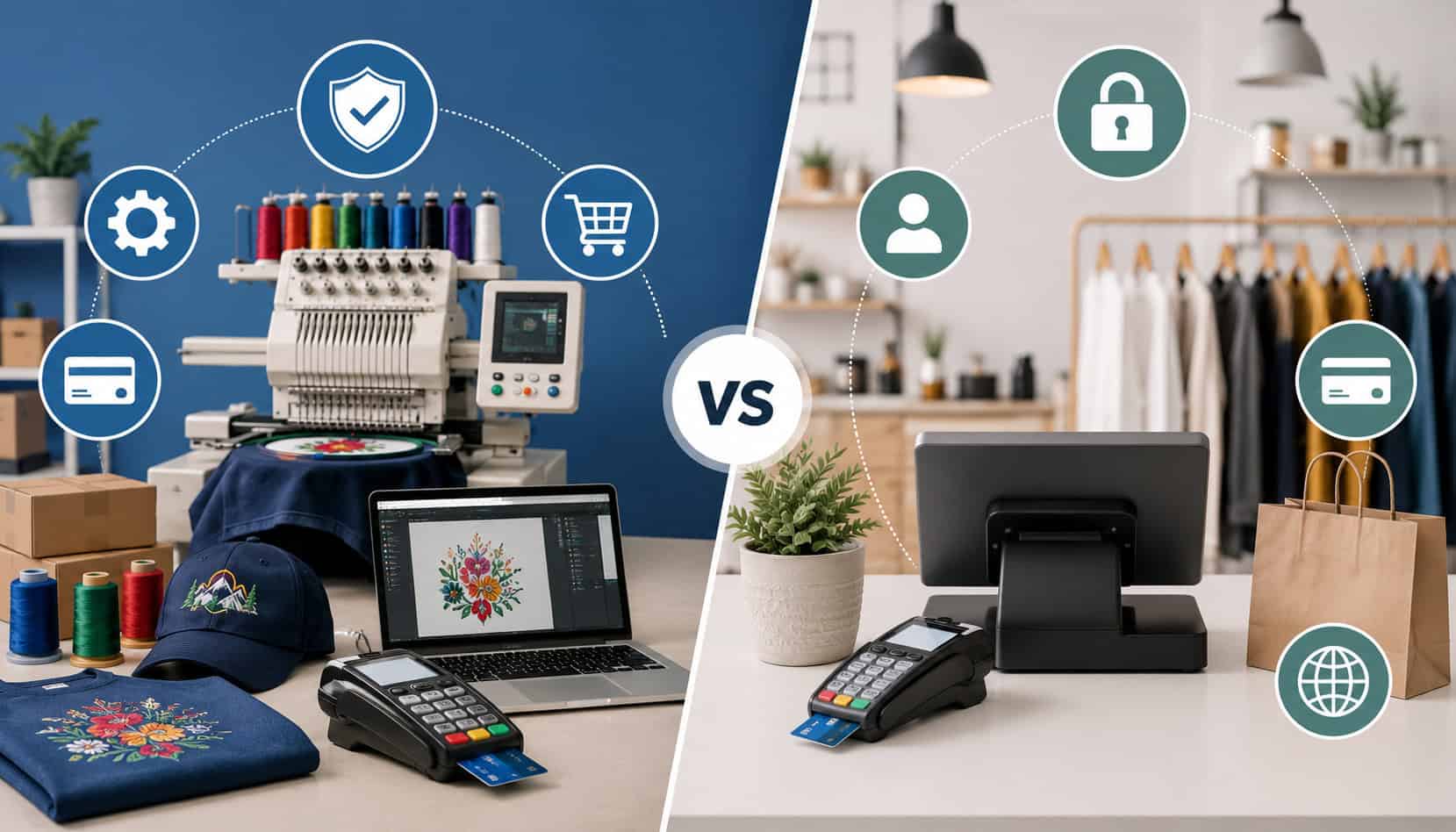
Running an embroidery business is not the same as selling simple off-the-shelf products. Customers may request logo digitizing, stitched names, thread color changes, garment sourcing, rush production, bulk quantities, and proof approvals before an order is finished. That makes payment processing more involved than simply swiping a card at checkout.
This is why the comparison between Embroidery Merchant Accounts vs Standard Merchant Accounts matters. Both options help businesses accept card payments, online payments, and customer payments, but they are not always built for the same workflow.
Embroidery businesses often need deposits before production, invoices for final balances, online checkout for custom apparel, payment links for approvals, and clear documentation to reduce chargebacks. They may also handle high-ticket custom orders for uniforms, branded merchandise, event apparel, team gear, or corporate gifts.
A standard merchant account can work for basic retail sales. However, embroidery merchant accounts are usually better aligned with the real payment needs of custom apparel businesses, especially when orders require multiple steps before delivery.
What Is an Embroidery Merchant Account?
An embroidery merchant account is a payment processing account designed to help embroidery shops accept and manage customer payments across different sales channels. It supports the way embroidery businesses actually sell: custom orders, deposits, invoices, online payments, in-person checkout, mobile payments, and final balance collection.
For example, a customer may order embroidered polos for a business team. The shop may need to collect a deposit before ordering garments, send an artwork proof for approval, adjust the invoice after size changes, and collect the remaining balance before pickup or shipping.
A standard checkout setup may process the card payment, but it may not provide the best workflow for approvals, partial payments, documentation, and dispute protection.
Embroidery merchant accounts often support:
- Card payments in-store
- Online payments for embroidery businesses
- Payment links and digital invoices
- Deposits for custom orders
- Final balance collection
- Mobile readers for events or pickup locations
- POS systems for embroidery shops
- Reporting for sales, refunds, deposits, and order tracking
A good embroidery payment processing setup should also help organize the payment side of custom work. That means keeping proof approvals, receipts, invoice notes, refund terms, and order details connected whenever possible.
For shops comparing options, resources on payment processing fees for embroidery shops can be helpful when reviewing total cost, not just advertised rates.
What Is a Standard Merchant Account?
A standard merchant account is a business account used to accept card payments and move funds from customer transactions into the business’s bank account. It usually supports common payment methods such as credit cards, debit cards, digital wallets, online checkout, and POS transactions.
For many basic retail businesses, a standard merchant account may be enough. A customer chooses an item, pays at the counter or online, receives the product, and the transaction is complete. The payment process is direct and usually does not involve proof approvals, custom production, partial payments, or long delivery timelines.
Standard merchant accounts commonly include:
- Card-present transactions
- Online payment gateway access
- Basic POS compatibility
- Settlement reporting
- Refund processing
- Transaction history
- Basic fraud screening
The challenge is that embroidery business payments are often more complex. A shop may take a deposit today, complete production later, and collect the remaining balance after the customer approves the finished work. A standard account may process each payment, but it may not provide the best support for the documentation and flexibility needed in custom apparel payment processing.
That does not mean standard merchant accounts are bad. They can be useful for shops selling ready-made patches, hats, gifts, or simple retail items. But when a business depends heavily on custom orders, bulk invoices, artwork approvals, and high-ticket custom orders, a more specialized setup may reduce friction.
Embroidery Merchant Accounts vs Standard Merchant Accounts: Key Differences
The biggest difference between embroidery merchant accounts and standard merchant accounts is not whether they can accept payments. Both can. The difference is how well they fit custom apparel workflows.
Embroidery businesses often combine retail, service, production, and ecommerce models. A single shop may sell monogrammed gifts at the counter, take online orders for embroidered hats, invoice a company for uniforms, and collect deposits for school apparel. That mix creates payment needs that standard accounts may not fully support.
A specialized account is often more useful when the business needs flexible invoices, secure online payments, chargeback documentation, card-present and card-not-present options, and POS tools that fit custom order management.
| Feature | Embroidery Merchant Account | Standard Merchant Account | Why It Matters |
| Custom deposits | Often supports deposits, partial payments, and balances | May support only basic transactions | Helps protect cash flow before production starts |
| Digital invoices | Useful for quotes, approvals, and final balances | May be limited or separate | Makes business and bulk orders easier to manage |
| Chargeback tools | Better aligned with proof approvals and custom order records | May offer basic dispute support | Documentation matters when custom work is disputed |
| Online payments | Supports ecommerce, payment links, and custom order checkout | Usually supports general online payments | Helps customers pay remotely and securely |
| POS compatibility | Can support embroidery-specific sales workflows | Usually supports standard retail checkout | Better for mixed in-store and custom orders |
| High-ticket orders | More focus on larger invoices and business clients | May be built around routine retail purchases | Helps manage risk on bulk apparel sales |
| Reporting | Can track channels, invoices, deposits, and sales types | May provide basic transaction reports | Better visibility supports pricing and cash flow |
| Payment security | Supports secure checkout, tokenization, and safer card handling | Varies by provider | Reduces exposure when taking remote payments |
Custom Order Payment Needs
Embroidery businesses rarely follow a one-step payment process. Many orders begin with a quote, then move to artwork review, garment selection, digitizing, approval, production, and final delivery. Each stage can affect the payment timeline.
A shop may need to collect a deposit before ordering blank garments or beginning digitizing work. This protects the business from spending money on materials before the customer has committed. For larger orders, progress payments or milestone payments may also make sense, especially when the order requires special inventory or rush production.
Final balance collection is another important issue. If the customer receives the finished order before paying the balance, the shop carries unnecessary risk. Online invoices, payment links, and stored approval records can help make final payment easier and more professional.
Merchant accounts for embroidery businesses should make these steps simple. The goal is not only to accept payment, but to create a clear payment trail that matches the order trail.
Chargeback and Dispute Risk
Chargebacks can be especially frustrating for embroidery shops because custom products are often hard to resell. If a customer disputes a personalized jacket, logo order, or bulk uniform purchase, the business may lose revenue, materials, labor time, and the finished goods.
Disputes often happen when expectations are not documented clearly. A customer may claim the thread color looked different than expected, the design placement was misunderstood, the delivery timing was unclear, or the final product did not match what they imagined. Even when the shop did the work correctly, weak documentation can make disputes harder to defend.
Strong embroidery payment processing should support better chargeback prevention. That means keeping written approvals, signed proofs, invoice details, refund terms, delivery confirmations, and customer communication organized.
For deeper background on how disputes work, this chargeback guide for merchants is a useful external reference.
Online and In-Person Payment Flexibility
Embroidery shops often sell in more than one place. A customer may visit the shop, approve artwork by email, pay an invoice from a phone, or reorder through an online store. Because of this, payment processing for embroidery shops should support both in-person and remote payments.
In-store POS systems are useful for walk-in customers, pickup payments, retail items, and local orders. Online payments are useful for deposits, ecommerce checkout, business invoices, and customers who are not physically present. Mobile readers can help when selling at events, markets, school functions, or pop-up locations.
The best setup depends on how the shop sells. A home-based embroidery business may rely heavily on invoices and online payments. A storefront may need a POS system and terminal. A growing custom apparel shop may need both, plus ecommerce integration.
Resources on integrating POS with online embroidery stores can help shops think through multichannel payment workflows.
Why Embroidery Businesses May Need Specialized Payment Processing
Embroidery businesses may need specialized payment processing because their sales are often custom, staged, and relationship-based. Unlike simple retail transactions, custom apparel orders may involve quotes, approvals, artwork revisions, garment sourcing, production scheduling, and final delivery. Payments need to fit that process.
A shop that serves schools, teams, clubs, businesses, event organizers, and repeat commercial clients may handle larger and more complex invoices than a typical retail store. These buyers may expect digital invoices, card payments, purchase records, and flexible payment options.
Specialized embroidery merchant accounts can help with:
- Deposits before production
- Online invoices for custom quotes
- Payment links after artwork approval
- Recurring billing for repeat clients
- Mobile payments at events
- Secure checkout for online stores
- Reporting by order type or sales channel
- Chargeback documentation for custom work
Rush orders are another reason payment flexibility matters. If a customer needs embroidered uniforms quickly, the shop may need immediate payment before rearranging production. Delayed payment can delay ordering blanks, scheduling staff, or starting digitizing.
High-ticket custom orders also require careful handling. A large branded apparel order can represent significant revenue, but it can also create risk if the customer cancels, disputes, or delays payment. Deposits, signed approvals, clear invoice terms, and secure payment workflows help reduce that risk.
Specialized payment processing does not mean every embroidery business needs a complicated system. It means the payment setup should match how the business earns money. A small monogram shop may need simple invoices and mobile payments. A larger custom apparel operation may need POS, ecommerce, recurring invoices, and detailed reporting.
Fees, Contracts, and Pricing Models to Compare

Merchant account fees can affect embroidery shop profitability, especially when margins are already shaped by garments, thread, stabilizers, labor, digitizing, software, shipping, and equipment costs. When comparing Embroidery Merchant Accounts vs Standard Merchant Accounts, do not focus only on the headline rate.
Payment processing costs may include transaction fees, monthly account fees, gateway fees, statement fees, PCI-related fees, chargeback fees, batch fees, equipment costs, and early termination fees. Some providers also charge for virtual terminals, payment links, invoicing tools, or POS software.
Common pricing models include:
- Flat-rate pricing: Simple and predictable, but not always cheapest at higher volume.
- Interchange-plus pricing: More transparent and often useful for growing shops.
- Tiered pricing: Can be harder to understand because transactions may fall into different rate categories.
- Subscription-style pricing: May work for higher-volume businesses if the monthly cost is justified.
Embroidery businesses should also consider how transaction type affects cost. Card-present payments at a terminal may price differently than online payments, invoice payments, manually keyed cards, or stored-card transactions. Since embroidery shops often use several payment methods, the effective rate can vary from month to month.
Contracts deserve careful review. A low advertised rate may be less attractive if the agreement includes long terms, expensive equipment leases, cancellation penalties, or unclear fee language. Ask for all pricing details in writing before signing.
Settlement timing is also important. If your shop pays suppliers upfront, slow deposits can affect cash flow. Faster access to funds may help when managing bulk orders, rush jobs, and seasonal demand.
Payment Security for Embroidery Shops
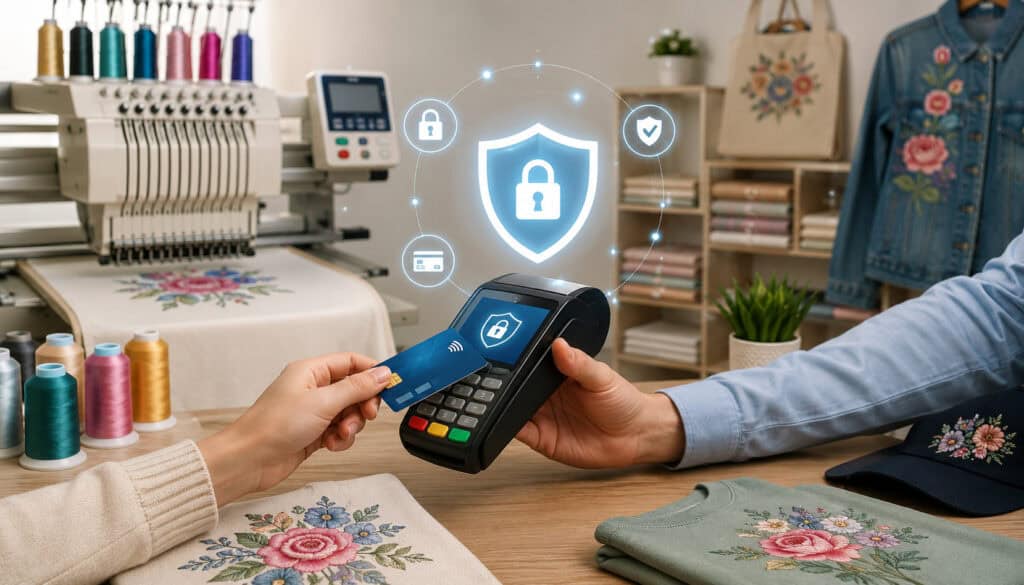
Payment security is essential for embroidery businesses because many shops accept payments in several ways: in person, online, by invoice, over the phone, or through stored customer profiles. Every payment channel should be handled carefully.
Secure payment processing helps protect customer card data and reduces business risk. Encryption protects data during transmission. Tokenization replaces sensitive card details with secure tokens so the actual card number is not stored in the shop’s system. Secure checkout pages help customers pay online without exposing card data through email or unsafe forms.
Embroidery shops should avoid writing card numbers on paper, saving card details in spreadsheets, or requesting payment information through unsecured messages. Even small businesses need disciplined payment habits.
Important security features include:
- Secure online checkout
- Tokenized stored payments
- User permissions for staff
- Refund controls
- Password-protected dashboards
- PCI-aware workflows
- Fraud screening tools
- Address verification when appropriate
- Receipt and invoice tracking
User permissions are especially useful when multiple employees handle orders. Not every staff member needs access to refunds, reports, stored payment tools, or account settings. Limiting access can reduce mistakes and internal risk.
Refund controls also matter. Custom apparel businesses should have clear refund policies, especially when personalized items cannot be resold. Payment tools should make refunds trackable and controlled rather than informal.
Payment security also supports trust. Customers are more likely to pay online when checkout looks professional and secure. Business clients may also expect organized invoices and proper payment handling.
How to Choose the Right Merchant Account for an Embroidery Business
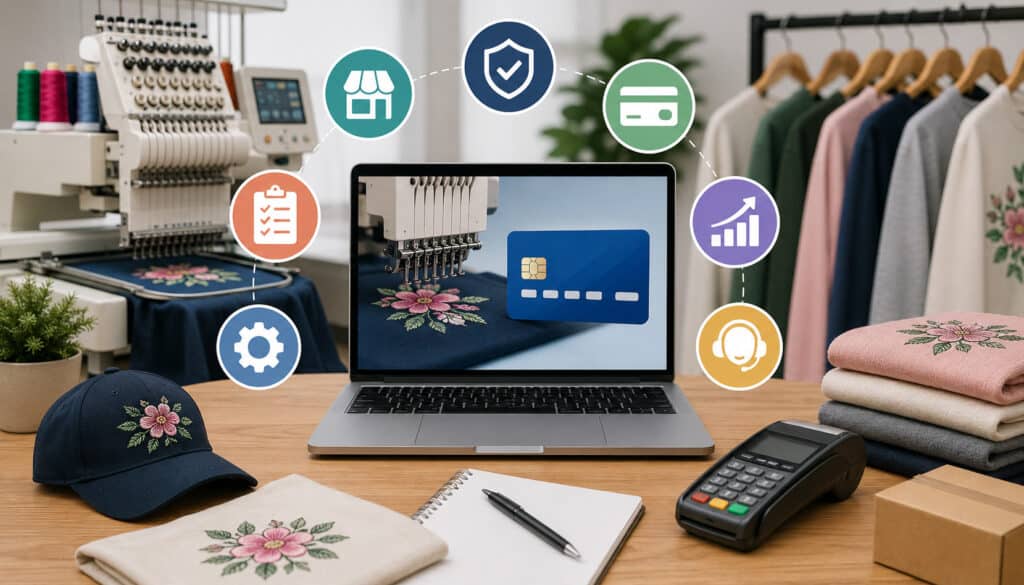
Choosing the right merchant account starts with understanding how your embroidery business sells. A storefront, home studio, online custom apparel shop, mobile embroidery vendor, and bulk uniform supplier may all need different payment setups.
Start by reviewing your sales channels. Do customers pay in person, online, through invoices, at events, or by phone? If most payments happen in-store, a strong POS system and reliable terminal may matter most. If many customers approve orders remotely, online payments and digital invoices may be more important.
Next, review the average order size. Small custom gifts may require low fixed transaction costs, while high-ticket custom orders may make percentage fees more important. Bulk orders may also require deposit tools and invoice tracking.
Look for features such as:
- Deposit and partial payment support
- Digital invoicing
- Secure online checkout
- POS system compatibility
- Mobile payment options
- Chargeback response tools
- Refund controls
- Ecommerce integration
- Reporting by channel
- Customer support
- Transparent merchant account fees
If your shop uses online ordering, review how payment tools connect with your website. If your team uses a POS system, check whether it can handle custom notes, order balances, inventory, and customer records. This article on how POS systems simplify custom orders in embroidery stores is useful when evaluating POS features.
Support is also important. When a payment fails, a batch does not settle, or a customer disputes a transaction, you need help quickly. Low pricing loses value if support is slow or unclear.
Finally, think about scalability. Your business may start with simple card payments and later need ecommerce, recurring invoices, multiple users, or more advanced reporting. Choose a system that can grow with you.
Common Mistakes to Avoid
One of the biggest mistakes embroidery businesses make is choosing payment processing based only on the lowest advertised rate. Low rates matter, but they are only one part of the decision. A provider with limited invoicing, poor chargeback support, or expensive add-on fees may cost more in the long run.
Another mistake is ignoring chargeback risk. Custom embroidery depends on customer expectations, and expectations must be documented. Without signed proofs, clear invoices, order notes, and delivery records, a shop may struggle to defend itself during a dispute.
Weak refund policies are also risky. Customers should know when deposits are refundable, when custom work becomes non-refundable, how artwork approvals work, and what happens if production is delayed. These terms should appear on quotes, invoices, receipts, or checkout pages.
Common mistakes include:
- Choosing only by rate
- Not collecting deposits
- Starting production without written approval
- Using unclear refund terms
- Accepting card details through unsafe methods
- Failing to document changes
- Not separating deposits from final balances
- Ignoring payment security
- Using a POS system that does not fit custom orders
- Not reviewing monthly statements
Poor invoice documentation can create confusion. If an invoice simply says “shirts” instead of listing garment type, quantity, logo placement, approval status, and payment terms, the business has less evidence if the customer disputes the order.
No deposit process is another common issue. Without deposits, the shop may absorb material costs and labor risk if a customer cancels after production begins.
What is an embroidery merchant account?
An embroidery merchant account is a payment processing account designed for embroidery shops and custom apparel businesses. It helps accept card payments, online payments, deposits, invoices, and in-person transactions.
It is especially useful for businesses that handle custom orders, branded apparel, uniforms, bulk merchandise, and personalized products. The right setup can support both customer convenience and better payment documentation.
How is it different from a standard merchant account?
A standard merchant account usually focuses on basic payment acceptance. It can process card payments, online payments, and POS transactions.
An embroidery merchant account is more focused on custom order workflows. It may better support deposits, payment links, digital invoices, chargeback documentation, POS systems for embroidery shops, and online payments for embroidery businesses.
Do embroidery shops need special payment processing?
Not every embroidery shop needs a highly specialized system, but many benefit from payment tools built for custom sales. If your shop collects deposits, sends invoices, takes online orders, handles bulk apparel, or manages proof approvals, specialized embroidery payment processing can be valuable.
A basic setup may be enough for simple retail sales. A more flexible setup is usually better for growing custom apparel payment processing needs.
Can embroidery businesses accept deposits online?
Yes. Many embroidery businesses can accept deposits online through secure invoices, payment links, ecommerce checkout, or customer portals.
Online deposits are useful because they allow production to begin only after payment is confirmed. They also create a digital record that can help with order tracking, customer communication, and dispute prevention.
How can embroidery shops reduce chargebacks?
Embroidery shops can reduce chargebacks by using clear invoices, written artwork approvals, detailed order descriptions, signed policies, delivery confirmation, and secure payment methods.
It also helps to communicate production timelines clearly. Customers should know when artwork will be approved, when production starts, when changes are allowed, and when final payment is due.
What fees should embroidery businesses expect?
Embroidery businesses may pay transaction fees, monthly fees, gateway fees, POS software fees, PCI-related fees, chargeback fees, equipment costs, and possible contract-related fees.
The exact cost depends on the provider, pricing model, sales volume, average order size, and payment channels. In-person payments, online invoices, keyed transactions, and ecommerce payments may all price differently.
Should embroidery shops use POS or online payments?
Many embroidery shops benefit from using both. POS systems are useful for storefront sales, pickup payments, retail items, and walk-in customers. Online payments are useful for deposits, invoices, ecommerce orders, repeat business clients, and remote approvals.
The best choice depends on how customers prefer to pay and how the shop manages orders. A combined setup often works best for businesses selling across multiple channels.
What features matter most for custom apparel payments?
The most important features include deposit support, digital invoicing, secure checkout, POS integration, mobile payments, chargeback tools, refund controls, customer records, reporting, and transparent fees.
For custom apparel payment processing, documentation is especially important. The payment system should help connect the transaction to the order, approval, invoice, and delivery record.
Conclusion
Embroidery merchant accounts and standard merchant accounts both help businesses accept payments. The key difference is how well each option supports the real workflow of custom embroidery sales.
Standard merchant accounts may work for basic card payments, simple online checkout, and routine POS transactions. But embroidery businesses often need more flexibility because they manage custom orders, deposits, invoices, approvals, bulk orders, online payments, high-ticket custom orders, and chargeback risk.
When comparing Embroidery Merchant Accounts vs Standard Merchant Accounts, focus on more than rates. Look at payment security, merchant account fees, deposit tools, POS systems for embroidery shops, online invoicing, reporting, support, and dispute protection.
The right payment setup should make it easier to get paid, protect your business, serve customers professionally, and keep custom orders moving from quote to completion.