By alphacardprocess March 8, 2026
Starting an embroidery business is exciting. You get to turn creativity into a real company, serve customers with custom products, and build a brand around quality, service, and craftsmanship.
But even the best designs and the cleanest stitching will not support long-term growth if getting paid is slow, confusing, or unreliable. That is why it is so important to set up payment processing for a new embroidery business the right way from the beginning.
Payment processing is more than just accepting credit cards. For an embroidery shop, it touches almost every part of daily operations.
It affects how you collect deposits on custom orders, how you send invoices to schools or business clients, how you handle in-person purchases, how you take online payments, and how smoothly money moves into your bank account.
A strong setup can improve cash flow, reduce missed payments, simplify bookkeeping, and make the buying experience easier for customers.
New embroidery businesses often serve more than one type of customer. You may sell custom uniforms to teams, personalized gifts to individual buyers, embroidered hats at events, or bulk apparel orders to local organizations.
Each type of sale may require a different payment flow. Some customers want to pay online when they place an order. Others may need an invoice. Some will pay a deposit up front and the balance later. A flexible system helps you handle all of that without piecing together too many tools.
In this guide, you will learn what payment processing really means in an embroidery and custom apparel context, what tools matter most, how to choose the right payment solutions for embroidery businesses, and how to build a setup that fits your business model.
You will also see step-by-step guidance for an embroidery business payment processing setup, common mistakes to avoid, and practical tips for managing payments as your business grows.
What Payment Processing Means for a New Embroidery Business
When people hear the phrase payment processing, they often think of a card terminal at a checkout counter. In reality, payment processing for embroidery businesses includes the full system that allows you to accept, manage, track, and reconcile customer payments across all the ways you sell.
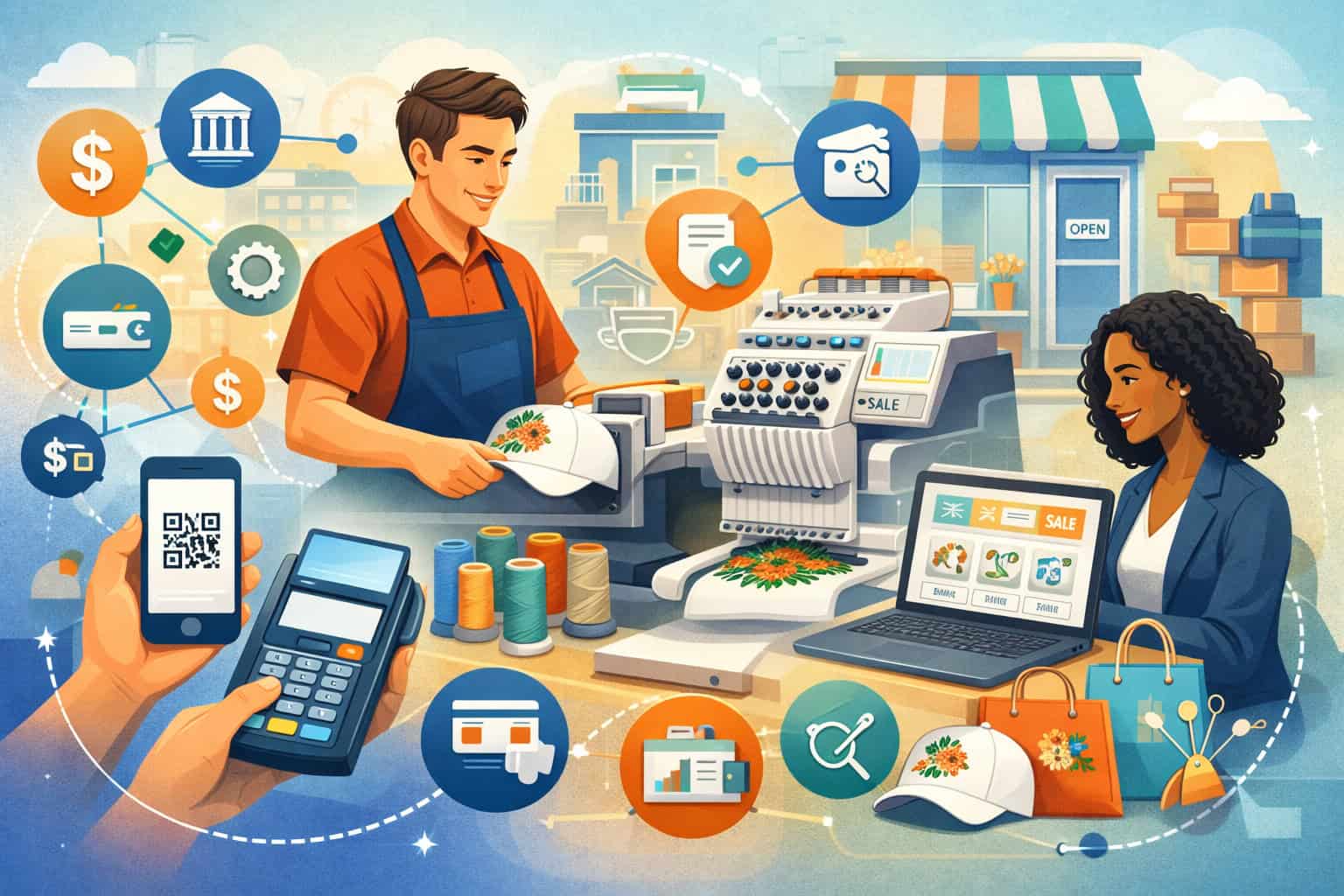
For a new embroidery business, this system may include a payment processor, a merchant account for embroidery business transactions, a payment gateway for your website, invoicing software, a mobile card reader for events, and possibly a POS system for embroidery shop operations. These tools work together to help customers pay you and help you keep records organized.
At the basic level, payment processing starts when a customer chooses a payment method. That could be a card, a digital wallet, an online checkout payment, or an invoice payment link. The payment system securely routes the transaction, checks for approval, and moves the funds to your business account according to your provider’s schedule.
Behind the scenes, the processor handles communication between the customer’s bank, the card network, and your merchant account or payment platform.
Why embroidery businesses have unique payment needs
Embroidery businesses do not always operate like standard retail stores. Many orders are customized, which means the payment structure often needs to support more than a one-time checkout.
You may need to collect a deposit before production begins, request approval on artwork before charging the final balance, or invoice a business customer after delivery.
That makes payment acceptance for custom embroidery orders more complex than a simple product sale. Your setup should support:
- Partial payments or deposits
- Final balance collection
- Custom quotes turned into invoices
- In-person and remote payment options
- Payment tracking by order or customer
- Easy communication with repeat clients
For example, if a customer orders embroidered polos for a staff team, you may quote the project first, collect a deposit once the order is approved, and send the balance invoice after the items are finished. Your system should make that process smooth, not manual and stressful.
The core tools behind an embroidery business payment setup
A complete embroidery shop payment setup usually includes several moving parts, even if you start simple. The exact combination depends on how and where you sell. Some businesses only need online invoicing and a mobile reader. Others need a full retail POS, e-commerce checkout, and customer account features.
Here are the main building blocks:
- Payment processor: The company that handles the transaction itself.
- Merchant account: A business account used to accept card payments, though some providers bundle this into one service.
- Payment gateway: The tool that securely processes online payments through your website.
- POS system: Useful for in-store payments, inventory, receipts, and order tracking.
- Invoicing tools: Great for custom jobs, deposits, and business clients.
- Mobile card reader: Helpful for pop-up events, markets, or on-site sales.
Why Payment Setup Matters From the Beginning

Many new business owners treat payment setup as a back-office task they can figure out later. For an embroidery business, that approach can create avoidable problems early on. A poor payment system can slow down cash flow, make custom orders harder to manage, and create friction at the exact moment a customer is ready to buy.
Choosing the right payment processing setup from the beginning gives your business a stronger foundation. It helps you look more professional, collect money faster, and keep operational details under control as orders increase.
Even if you are starting small from home, the way you accept payments affects how customers perceive your business and how smoothly your day-to-day workflow runs.
A customer ordering custom embroidered items often has questions, approvals, design changes, and delivery needs. The payment process should feel organized and trustworthy.
If your invoicing is unclear, your deposit terms are inconsistent, or your checkout options are limited, customers may hesitate. On the other hand, a clean and simple system builds confidence and helps close sales.
Better cash flow starts with better payment systems
Embroidery businesses often have upfront costs. You may need to purchase blanks, stabilizers, thread, packaging, or rush supplies before the order is complete. If you are not collecting deposits or final payments efficiently, your cash flow can tighten quickly.
The right payment solutions for embroidery businesses make it easier to collect money at the right stages. That may include:
- Taking a deposit before production starts
- Sending automatic invoice reminders
- Accepting payment links by email or text
- Offering online checkout for ready-to-order products
- Processing cards on the spot for walk-in customers
This structure helps you avoid chasing payments while still delivering a professional customer experience. It also protects your working capital, which matters even more when you are trying to grow.
Customer convenience can directly affect sales
People are more likely to complete a purchase when payment feels easy and familiar. Some customers want to tap a card in person. Others want to pay from their phone. A school buyer or company office manager may need an invoice with clear terms. Your payment setup should match these expectations without forcing every customer into one method.
Credit card processing for embroidery shops is important, but it is only one part of the larger picture. Online payments for embroidery businesses, invoice payments, mobile checkout, and digital wallet support all contribute to a better buying experience.
If customers have to jump through too many hoops to pay, you risk delays, abandoned orders, or lost business altogether.
Payment Methods and Tools a New Embroidery Business May Need

A new embroidery business does not need every payment tool on day one, but it does need the right ones. The goal is to build a system that matches how you sell now while leaving room to grow.
That might mean starting with invoicing and a mobile card reader, then adding a website checkout, POS system, or customer account features as your order volume increases.
The best payment processing for embroidery businesses usually supports multiple ways to accept money because the business itself often works across multiple channels.
You might sell custom jackets to a business client one week, process online monogram orders the next, and attend a local vendor event on the weekend. A one-size-fits-all approach usually falls short.
In-person payment tools for retail, pick-up, and event sales
If you have a storefront, showroom, home studio with customer pickup, or event booth, you need a reliable way to accept in-person payments. This usually includes a mobile card reader or countertop terminal and, in some cases, a POS system for embroidery shop transactions.
A good in-person setup can help with:
- Credit and debit card acceptance
- Tap-to-pay and digital wallet payments
- Receipt generation
- Sales reporting
- Product and inventory tracking
- Staff access if you have a team
For very small operations, a simple card reader linked to an app may be enough. For a retail embroidery shop with ready-made apparel, gifts, or accessories, a full POS can provide more control over inventory and sales records.
Mobile payments for embroidery business owners are especially helpful if you attend fairs, craft markets, sports tournaments, school functions, or community events. These tools let you process payments anywhere with the right connection and can keep you from losing impulse sales.
Online and remote payment tools for custom orders
A large share of embroidery orders happen without a customer standing in front of you. They may start through email, social media, a website inquiry form, or a phone call. That is why online payments for embroidery businesses matter even if you do not run a large online store.
Useful remote payment tools include:
- Online invoices with payment buttons
- Secure payment links
- Website checkout pages
- Deposit request forms
- Virtual terminal access for phone orders
- Hosted checkout options through a payment gateway
These tools are especially useful for custom apparel jobs. A customer may review a quote, approve the details, and then pay a deposit online. That is much easier than asking them to call you back later with a card number or mail a check.
Embroidery business invoicing tools are also important for customers who need documentation, such as schools, clubs, nonprofit groups, contractors, and company buyers. A polished invoice can make your business look established and make payment faster and easier to track.
Merchant services, gateways, and account structure
As you compare embroidery merchant services, you will likely come across terms such as merchant account, processor, gateway, and POS platform. These are related, but they are not all the same.
A merchant account for embroidery business transactions is typically the account that allows your business to accept card payments. Some providers give you a dedicated merchant account. Others offer an all-in-one model where processing and account services are bundled into one platform.
A payment gateway for custom apparel business sales is the technology that securely handles online checkout transactions. If you plan to sell through a website, take deposits online, or accept invoice payments through a portal, this matters. Not every gateway works equally well with every website platform, so compatibility matters.
Step-by-Step Guide to Setting Up Payment Processing
If you are starting from scratch, the process can feel overwhelming. The good news is that you do not need to build everything at once. A practical embroidery business payment processing setup starts with understanding your sales flow, choosing the right provider, and putting the basic tools in place in the right order.
The key is to set up payment processing in a way that supports how your embroidery business actually works. You want enough flexibility for custom jobs, enough structure for accurate records, and enough convenience for customers to pay without delay.
Step 1: Map your sales channels and payment scenarios
Before you choose any provider, list the main ways you expect to sell. This step helps you avoid paying for tools you do not need or choosing a provider that cannot support how you operate.
Ask yourself:
- Will I sell in person, online, or both?
- Will I take custom orders with deposits?
- Will I invoice business or organization clients?
- Will I attend events or pop-ups?
- Will I need a shopping cart for ready-made products?
- Will customers pay at pickup, at checkout, or after delivery?
An embroidery business that only accepts local custom orders may need invoicing, deposit collection, and a mobile card reader. A growing online seller may need a payment gateway, website checkout, and recurring invoicing for repeat buyers. A storefront may need all of the above plus a POS system.
Once you identify these needs, you can evaluate payment solutions based on fit rather than hype.
Step 2: Choose a payment processor and merchant setup
Next, compare providers that handle payment processing for embroidery businesses. Focus on transparency, flexibility, customer support, and how well the tools match your order flow. Look beyond headline rates and think about the real cost of doing business.
Pay attention to:
- Processing fees for card-present and card-not-present sales
- Monthly fees or platform costs
- Hardware pricing
- Invoice and payment link features
- Online checkout tools
- Deposit and partial payment support
- Reporting quality
- Funding speed
- Customer support availability
Also review the application or approval process. Some providers are fast and simple. Others may request more business details, banking information, or documentation. Since embroidery businesses often involve custom goods, clear policies and good documentation can help reduce issues later.
Step 3: Set up invoicing and deposit collection first
Even before you launch a website or buy retail hardware, make sure you can send invoices and collect deposits. This is one of the most practical early steps for a new embroidery business.
Your invoicing setup should allow you to:
- Create itemized quotes or invoices
- Add due dates and payment terms
- Accept online payments directly from the invoice
- Collect partial payments or deposits
- Track unpaid balances
- Send reminders when needed
This matters because custom embroidery orders usually involve some back-and-forth. Once the customer approves the order details, you should be able to send a payment request quickly and move the job into production without friction.
Step 4: Add online checkout if you sell through a website
If your embroidery business has an online store, product catalog, or custom order form, the next step is setting up online checkout. This usually requires a payment gateway or integrated e-commerce payment tool.
Your website payment setup should make it easy for customers to:
- Add products to a cart
- Upload or reference customization details
- Pay securely online
- Receive confirmation after purchase
- Contact you if order clarification is needed
For made-to-order embroidery, some businesses sell standard custom products online with defined personalization fields. Others use a quote-first process and then send payment links after approval. Both models can work, but your payment system should match your order complexity.
A simple, secure checkout is better than an overly complicated one. If your online process is confusing, customers may leave before completing the order.
Step 5: Set up in-person and mobile payment acceptance
Once your remote payment tools are working, add in-person payment acceptance if needed. For many embroidery businesses, this includes a mobile reader for pickups and events or a more advanced POS system for embroidery shop use.
Test the full process before using it with customers. Make sure you know how to:
- Accept different card types
- Issue refunds if necessary
- Email or print receipts
- Track sales by item or category
- Record cash or other payment methods if applicable
If you sell at events, check how the system performs in mobile settings and what backup options exist if internet service is weak. A dependable mobile payment tool can make a major difference during busy sales days.
Step 6: Connect payments to your workflow and records
The last major setup step is connecting your payments to the rest of your business operations. Payment processing should not sit on an island. It should support your order management, bookkeeping, customer communication, and reporting.
At minimum, you should be able to match payments to:
- Customer names
- Order numbers
- Invoice numbers
- Sales channels
- Deposit versus final balance
- Fulfillment status
This becomes especially important as volume grows. Without a clean system, it becomes easy to lose track of who paid, what stage an order is in, and whether your books are accurate.
Features to Look for in a Payment Solution
Choosing the right provider is not only about price. A low rate can be less valuable than a system that saves time, reduces mistakes, and supports the way your embroidery business actually operates.
The right feature set depends on your business model, but there are several capabilities that are especially useful for embroidery shops and custom apparel sellers.
When evaluating payment solutions for embroidery businesses, focus on flexibility, visibility, and customer convenience. Since custom orders often involve more steps than standard retail, your tools should support those extra layers without adding unnecessary complexity.
Pricing transparency and flexible payment flows
Transparent pricing is one of the most important features to look for. New business owners often compare payment providers based only on a published transaction rate, but the true cost may include monthly platform fees, hardware fees, gateway fees, chargeback fees, PCI-related fees, or extra costs for invoicing and virtual terminal access.
You should understand:
- What you pay per transaction
- Whether card-present and online rates differ
- Whether there are monthly or annual fees
- Whether invoicing or hosted payment pages cost extra
- What hardware costs up front
- What happens if you need support or dispute help
Beyond pricing, flexible payment flows matter just as much. Embroidery businesses often need to collect deposits, request final balances, and accept payment at different stages. A provider that supports partial payments, invoice links, and multiple acceptance methods will likely serve you better than a basic retail-only tool.
Invoicing, reporting, and integration support
Strong embroidery business invoicing tools can save hours of administrative work. The best systems let you send clear invoices, accept payments online, track due dates, and see which customers still owe balances. For custom work, being able to connect invoices to specific orders is especially useful.
Reporting matters too. You should be able to see:
- Sales by day, week, or month
- Paid versus unpaid invoices
- In-person versus online sales
- Refunds and chargebacks
- Payment status by order
- Customer purchase history when possible
If your payment platform integrates with bookkeeping tools, e-commerce systems, or inventory software, that can reduce manual entry and improve accuracy. For a growing business, these connections become more valuable over time.
Mobile access, security, and customer-friendly options
Modern payment systems should work well whether you are at your desk, in your shop, or at an event. Mobile access helps you send invoices, check payment status, or take payments while away from your main workstation. That can be especially important for home-based businesses or owners managing production and customer service at the same time.
Security features matter as well. You should look for a provider that helps support secure processing, encrypted payment handling, and tools that reduce the need for you to manually handle sensitive card data. This is part of maintaining trust and reducing risk.
Customer-friendly payment options also make a difference. Depending on your audience, that may include:
- Credit and debit cards
- Tap-to-pay
- Digital wallets
- Secure online invoice payments
- Stored customer profiles for repeat orders when appropriate
- ACH or bank transfer options for larger invoices if supported
Common Setup Mistakes and How to Avoid Them
A new embroidery business has plenty to juggle, so it is easy to overlook payment setup details until a problem appears. Unfortunately, payment mistakes can affect cash flow, customer trust, and operational efficiency all at once. Avoiding a few common errors early can save a lot of stress later.
The most common issue is choosing tools too quickly without thinking through how orders will be quoted, approved, paid, and fulfilled. Another frequent problem is relying on one payment method when customers actually need several.
Some businesses also launch without clear deposit policies or without testing the full payment flow before taking real orders.
Choosing based on rates alone
Low rates can be attractive, especially when you are watching every expense. But pricing should not be the only factor in your embroidery shop payment setup. A slightly cheaper provider may cost more in lost time, poor support, weak invoicing, or limited functionality.
For example, if your system cannot easily collect deposits, you may spend extra time sending manual reminders and reconciling balances. If it does not integrate with your online store or reporting process, you may create more work for yourself every week. Over time, these hidden costs add up.
Instead of asking only, “What is the rate?” ask:
- Does this support the way I take custom orders?
- Can customers pay how they prefer to pay?
- Will this save me time in invoicing and tracking?
- Does this help me stay organized as sales increase?
Failing to set policies for deposits, approvals, and refunds
Payment tools are only part of the picture. You also need clear business policies. Many embroidery orders are personalized or made to order, which means you should define when payment is due, whether a deposit is required, what happens after artwork approval, and how refunds are handled.
Without clear policies, disputes and misunderstandings become more likely. Customers may assume production starts before payment. They may think a custom order can be canceled after materials are ordered. Or they may be surprised by a balance request at pickup.
Put your policies in writing and include them where appropriate on quotes, invoices, checkout pages, or order forms. Keep them easy to understand and consistent across channels.
Not planning for chargebacks, security, and website setup
Card-not-present sales, custom orders, and remote payments can all increase the need for good recordkeeping. If a customer disputes a charge, you need supporting documentation such as invoices, order approvals, communication records, and delivery details. This is especially important for custom embroidery work.
Security also matters. Avoid collecting full card information through unsecured messages or handwritten notes. Use secure invoicing, hosted payment pages, or a virtual terminal if your provider offers one. If you sell online, make sure your checkout is properly connected and tested before launch.
How to Choose the Right Payment Setup for Your Business Model
Not every embroidery business needs the same setup. A home-based monogram business operates differently from a retail embroidery shop.
A custom apparel seller with an online catalog has different needs than a company focused on invoice-based business accounts. The best way to choose the right payment processing for embroidery businesses is to match the setup to your business model.
Your ideal combination of tools depends on how customers buy, how complex your orders are, where payments happen, and how much administrative work you want to manage manually. Thinking in terms of business model instead of generic software categories can help you make smarter decisions.
Home-based and custom-order-focused embroidery businesses
If you run a small home-based embroidery business, you may not need a full retail POS system right away. Many owners in this stage mainly need a simple but professional way to quote jobs, collect deposits, send invoices, and accept payment at pickup or delivery.
A practical setup often includes:
- Online invoicing with payment links
- Deposit collection tools
- A mobile card reader for in-person payments
- Basic reporting
- Optional website payment forms or hosted checkout pages
This kind of setup keeps costs manageable while giving customers a polished experience. It also works well for personalized orders, gift items, baby products, team apparel, and local pickup sales.
Retail embroidery shops and walk-in stores
A brick-and-mortar embroidery business usually needs more structure. In addition to custom order billing, you may sell ready-made products, accessories, blanks, or promotional merchandise. In this case, a POS system for embroidery shop use can be very valuable.
Look for a setup that supports:
- Fast checkout for walk-in customers
- Inventory tracking
- Product categories and SKU management
- Customer profiles
- Receipts and return handling
- Separate workflows for custom orders and retail sales
You may also need integrated invoicing if you handle both immediate purchases and custom jobs. The key is choosing a system that can support both without creating confusion.
Online sellers and multi-channel brands
If you sell heavily online or across multiple channels, your payment setup needs to connect more pieces. That may include a website checkout, payment gateway for custom apparel business sales, invoice tools for larger orders, and mobile payments for in-person events.
A multi-channel brand often benefits from:
- E-commerce integration
- Mobile-friendly checkout
- Secure payment gateway support
- Invoicing for large or custom projects
- Unified reporting across channels
- Customer account or repeat billing features when relevant
As your brand grows, the ability to see all payment activity in one place becomes more important. It can help you understand where sales come from, how repeat buyers behave, and which channels are most profitable.
Best Practices for Managing Payments as Your Embroidery Business Grows
Setting up payment processing is only the beginning. Once your embroidery business starts gaining traction, the real value comes from managing payments in a way that supports growth, keeps customers happy, and protects your time. As orders increase, small inefficiencies can become bigger problems. That is why it helps to build good habits early.
A strong payment process supports more than collections. It helps with customer communication, order accuracy, bookkeeping, and forecasting. When payments are organized, you can see what has been paid, what is overdue, what is in production, and what revenue is actually available to support the business.
Standardize your payment workflows
One of the best things you can do as volume grows is standardize the way payments are handled. That does not mean every customer has to use the exact same method, but it does mean your internal process should be consistent.
For example, you might create a standard workflow like this:
- Quote is approved
- Deposit invoice is sent
- Production starts after deposit payment
- Final invoice is sent before pickup or shipment
- Order is marked complete after full payment
This kind of structure reduces confusion for you and for customers. It also makes training easier if you eventually add team members.
Standard workflows are especially helpful when handling repeat clients, school orders, staff uniforms, or company merchandise programs. Those relationships often involve recurring projects, and consistency builds trust.
Keep payments connected to accounting and fulfillment
As the business grows, disconnected systems create problems. If payment records are separate from your invoices, order status, and bookkeeping, it becomes harder to understand your real financial position.
At a minimum, your payment data should help you answer:
- Which orders are fully paid?
- Which invoices are still open?
- Which deposits have been collected?
- What revenue came from retail versus custom jobs?
- What needs to be matched in bookkeeping?
The more clearly payments connect to your workflow, the easier it is to make good business decisions. This matters for reordering supplies, scheduling production, planning staffing, and understanding margins.
Review customer experience regularly
Payment systems should not stay untouched forever. As your embroidery business grows, customer expectations may shift. You may start taking larger orders, adding online sales, or working with more corporate and repeat clients. Reviewing the customer payment experience every few months can help you spot friction points.
Pay attention to questions like:
- Are customers confused about deposits?
- Are invoices getting paid quickly?
- Are online customers dropping off at checkout?
- Are event sales easy to process?
- Are repeat clients asking for easier billing options?
These patterns can show you where to improve. A better invoice layout, simpler checkout page, or clearer payment policy can make a measurable difference.
Pro Tip: Growth often exposes weak processes. When a payment issue repeats more than once, treat it as a system problem to fix, not just a one-time inconvenience.
Frequently Asked Questions
Q.1: How much does it cost to set up payment processing for a new embroidery business?
Answer: The cost depends on the provider, the tools you need, and how you sell. Some businesses can start with very low upfront costs using invoicing software and a basic mobile card reader.
Others may invest more in a POS system, website checkout, or integrated order tools. In addition to transaction fees, review any monthly service fees, hardware costs, gateway fees, and chargeback-related fees so you understand the full picture.
Q.2: Do I need a merchant account for embroidery business sales?
Answer: In many cases, yes, though some modern platforms bundle merchant account functions into an all-in-one payment service.
If you plan to accept card payments regularly, you need some form of merchant setup that allows those transactions to be processed and deposited into your business bank account. The best option depends on your volume, sales channels, and whether you want a dedicated or bundled setup.
Q.3: What is the best way to collect deposits for custom embroidery orders?
Answer: The most practical option is usually an online invoice or payment request that allows partial payment. This creates a record of the transaction and gives the customer a secure, convenient way to pay. A clear deposit policy should explain when the deposit is required, whether production begins after payment, and when the remaining balance is due.
Q.4: Can I accept online payments for embroidery businesses without a full e-commerce store?
Answer: Yes. Many new embroidery businesses start by sending invoices, payment links, or hosted checkout pages instead of building a full online store right away. This works especially well for custom orders that require quoting or approval before payment. You can still offer secure online payments without maintaining a large catalog-based website.
Q.5: What kind of POS system for embroidery shop operations makes sense?
Answer: That depends on whether you run a retail environment, how much inventory you carry, and how often you process in-person sales. A simple card reader may be enough for pickup payments and occasional events.
A full POS system is more useful if you sell ready-made goods, track inventory, manage staff access, or need stronger in-store reporting.
Q.6: How can I reduce chargeback risk with custom embroidery orders?
Answer: Good documentation is your best protection. Keep records of quotes, customer approvals, artwork or design confirmations, invoice history, communication, and proof of delivery or pickup.
Use secure payment tools rather than collecting card details informally. Clear refund and cancellation policies also help set expectations before production begins.
Q.7: What payment solutions for embroidery businesses work best for repeat clients?
Answer: Repeat clients often benefit from invoicing tools, saved customer profiles where appropriate, and streamlined reorder workflows.
If you serve schools, businesses, teams, or organizations, look for tools that let you send professional invoices, track account history, and manage recurring or repeat projects efficiently. The best solution is one that makes reordering easy while keeping billing organized.
Conclusion
To set up payment processing for a new embroidery business successfully, start by thinking about how your customers actually buy from you.
A good setup should support custom orders, deposits, invoices, in-person sales, online checkout, and the everyday realities of running an embroidery business. It should also make life easier for you, not just help you accept cards.
The right payment processing for embroidery businesses can improve cash flow, create a more professional customer experience, and reduce administrative headaches.
Whether you are launching from home, opening a shop, selling online, or building a multi-channel custom apparel brand, your payment system should fit your order flow, sales channels, and growth plans.
Focus on the essentials first: a reliable processor, secure payment acceptance, strong invoicing tools, and a clear deposit policy. From there, add the tools that match your business model, such as a payment gateway, mobile reader, or POS system for embroidery shop operations.
When your payment setup is built with intention, it becomes more than a checkout tool. It becomes part of a stronger, more organized, and more scalable business.