By alphacardprocess March 8, 2026
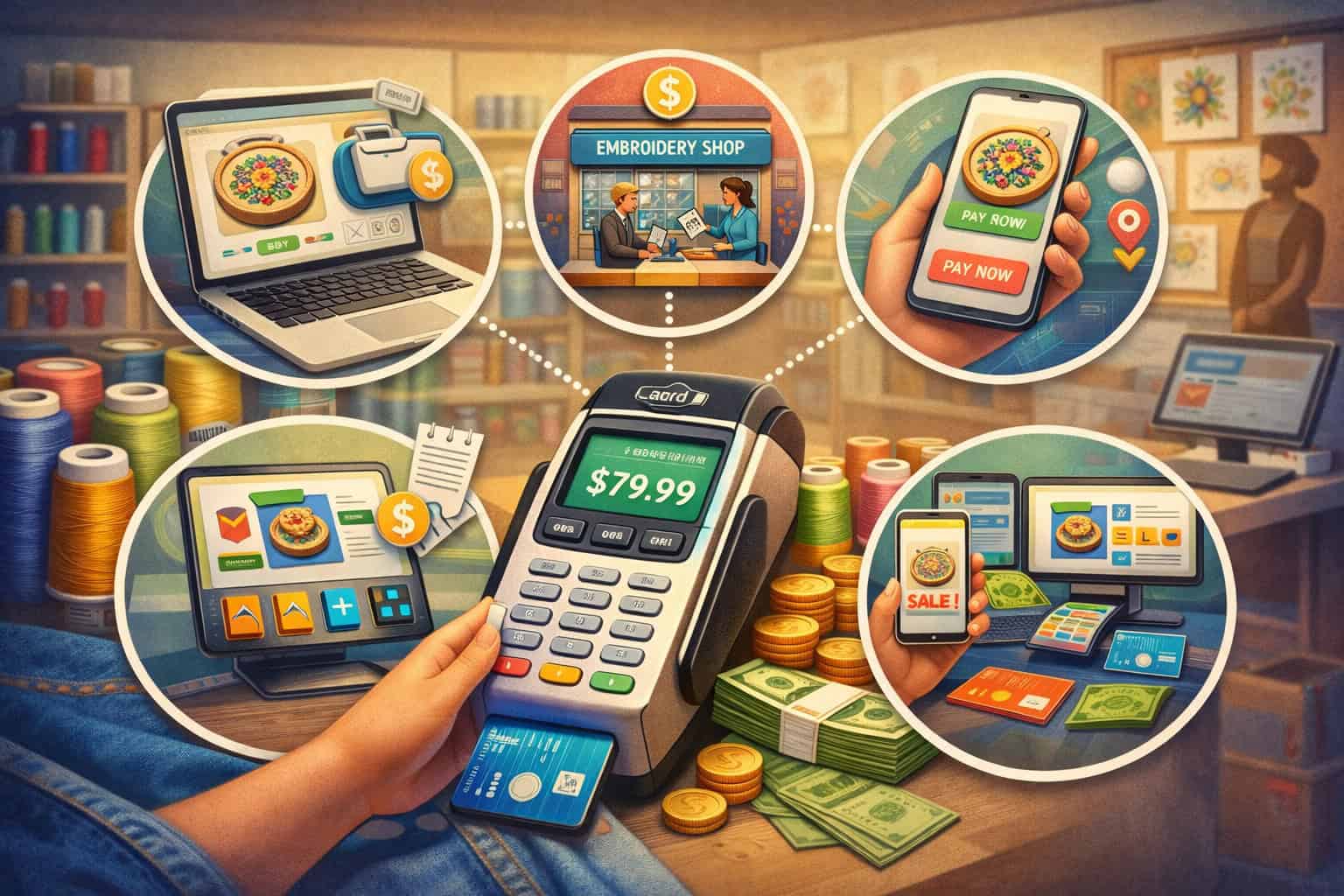
Embroidery shops rarely sell in just one place anymore. A customer might place a custom hat order in person, approve a logo mockup by email, pay a deposit through an invoice link, and return later to pay the balance at pickup.
Another customer may discover your business on social media, place an online order for branded polos, and ask for local pickup. A school booster club might reorder spirit wear over the phone, while a corporate client wants monthly billing for employee uniforms.
That is exactly why omnichannel payment processing for embroidery shops matters. It helps bring all of those sales and payment touchpoints into one connected system so your business is not constantly switching between separate tools, tracking down missing payments, or manually matching orders to transactions.
For embroidery businesses, payments are tied closely to production, approvals, fulfillment, and customer communication. Custom orders often involve deposits, design changes, bulk pricing, repeat orders, and pickup or delivery coordination.
When payment tools are disconnected from your point-of-sale system, online store, invoicing software, or order records, simple jobs can become harder than they need to be.
This guide explains what omnichannel payment processing means in a practical embroidery shop setting, why it matters, what tools and features are worth looking for, and how to build a setup that supports smoother operations without adding unnecessary complexity.
Whether you run a small home-based custom apparel business, a storefront embroidery shop, or a growing multi-channel brand, the right payment workflow can save time, improve customer experience, and give you a clearer view of how money moves through your business.
What Omnichannel Payment Processing Means for Embroidery Shops
At its core, omnichannel payment processing means your business can accept payments across multiple sales channels while keeping those transactions connected inside one unified system or closely integrated workflow.
Instead of treating your retail counter, online store, invoice payments, phone orders, mobile events, and repeat client billing as separate worlds, an omnichannel setup ties them together.
For embroidery shops, that connected view matters because orders often move across channels before they are complete. A customer may start with a quote request online, approve the order through email, pay a deposit from a digital invoice, and then settle the final payment in person.
Without connected systems, staff may need to re-enter order details, manually confirm balances, and update multiple platforms. With stronger embroidery shop omnichannel payments, the transaction history, order details, and customer record can stay more aligned from start to finish.
This is different from simply accepting cards in more than one place. Many businesses can take payments online and in person, but that does not automatically mean they have an omnichannel system.
If each channel has different reporting, separate customer records, and no shared order or payment visibility, the business is still managing disconnected payment streams.
A better omnichannel setup typically connects tools such as:
- A retail POS for counter sales and pickups
- An eCommerce store for online ordering
- An invoicing tool for deposits, approvals, and final balances
- Mobile payment devices for markets, pop-ups, and on-site sales
- Accounting software for reconciliation
- Inventory or order management systems for production tracking
- CRM or customer profiles for repeat orders and saved preferences
When these tools work together, omnichannel payments for embroidery businesses become more than a convenience feature. They become part of a smoother order management process. Staff can see what was paid, how it was paid, what is still due, and how that payment connects to production and delivery.
Omnichannel vs. Multichannel in an Embroidery Business
Embroidery shops often operate as multichannel businesses before they become truly omnichannel. Multichannel means you sell in different places. Omnichannel means those places are connected in a way that creates a more consistent experience for both the customer and your team.
That distinction matters. A shop may have a website, a counter terminal, and invoice software, but if none of them share customer data, sales history, or payment records, the business still has to do extra manual work.
A customer who paid a deposit online may not appear in the POS record at pickup. An online order might not sync with the inventory system. A repeat corporate account might have billing details stored in one platform and job history in another.
In a true omnichannel flow, the handoff between channels feels cleaner. The customer gets more flexible payment options, and the shop gets fewer administrative headaches.
That is why many integrated payment systems for embroidery shops focus on syncing transactions, customer records, and sales reporting rather than just enabling payment acceptance on multiple devices.
Why This Matters More for Custom Order Businesses
Embroidery businesses have payment needs that differ from simple retail stores. Many orders are built around customization, artwork approval, order minimums, partial payments, and production timelines. A basic one-step checkout is often not enough.
For example, you may need to:
- Take a deposit before production begins
- Collect the balance once items are completed
- Charge custom setup or digitizing fees
- Accept card payments for walk-in orders
- Send invoice links to schools, teams, or business buyers
- Save payment methods for repeat clients
- Handle large reorders with fast account-based billing
Because of that complexity, payment processing for embroidery shops works best when it supports how custom jobs actually move through the business. The more your payment system reflects your real workflow, the less friction you will have between sales, production, fulfillment, and bookkeeping.
Why Omnichannel Payments Matter in Custom Apparel and Embroidery Businesses
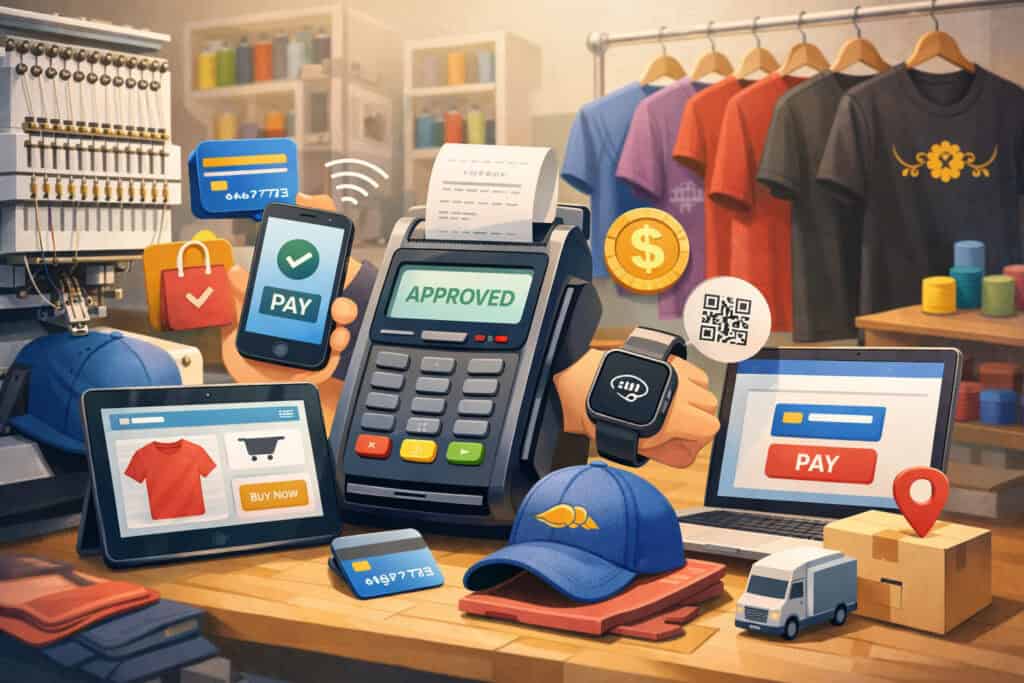
Embroidery shops are part retail business, part service business, and part production operation. That mix creates payment challenges that many standard storefronts do not deal with.
You are not just ringing up finished goods from a shelf. You are often managing made-to-order apparel, custom artwork, variable quantities, rush jobs, account clients, and recurring reorders.
That is why omnichannel payment processing for embroidery shops is so valuable. It creates a framework for handling the full payment journey more smoothly, even when that journey starts in one channel and ends in another.
Customers now expect flexibility. Some want to pay in person using tap-to-pay. Others want a secure invoice link. Some prefer online checkout, while business buyers may need payment options that fit internal purchasing workflows.
If your payment system only works well in one channel, it can slow down sales or create friction at the exact moment the customer is ready to buy.
From the business side, the importance goes even deeper. Embroidery shops often work with schools, nonprofits, sports teams, contractors, restaurants, churches, and local brands.
Those buyers may place repeat orders, request quotes, and split their payment process across several steps. A disconnected system makes those relationships harder to manage. A connected one supports better service, faster processing, and stronger visibility.
Omnichannel systems also reduce confusion internally. When the team can see payment status, order history, and customer activity in a more centralized way, it becomes easier to answer questions like:
- Has the deposit been paid yet?
- Was this reorder placed online or by invoice?
- Did the customer already pay at the event booth?
- Is the final balance still due at pickup?
- Has this account purchased these items before?
That visibility can reduce wasted time and lower the risk of errors. It also helps shops build a more professional buying experience, especially when customers return for additional orders.
Better Convenience for Customers Means Fewer Lost Sales
A lot of embroidery orders do not happen on impulse. They often involve communication, planning, and follow-up. That means the easier it is for customers to pay when they are ready, the better your chances of closing the sale without delay.
A customer may approve a proof while away from the shop and want to submit the deposit immediately. A coach ordering uniforms may need an invoice link to forward for approval. A business owner reordering staff polos may not want to call in a card each time. When payment options are limited, those orders can stall.
Online and in-store payment solutions for embroidery businesses help remove that friction. Instead of forcing every customer into the same process, an omnichannel approach supports the ways different buyers actually purchase. That does not just improve convenience. It can improve conversion, repeat business, and customer confidence.
Stronger Internal Control Without Making the Business Feel Rigid
One concern some shop owners have is that more systems will create more complexity. That can happen when tools are layered on without a plan. But a well-designed omnichannel payment workflow usually does the opposite. It makes the business easier to manage because more information lives in fewer places.
With better embroidery business payment solutions, you can standardize how deposits are collected, how balances are tracked, and how staff confirm payments across channels. That reduces the chance of missed charges, duplicate entries, or confusion during pickup and fulfillment.
For growing shops, this is especially important. What works when one owner manages every order can start breaking down once multiple staff members handle sales, customer service, and production coordination. An omnichannel setup creates more consistency without forcing every order into a one-size-fits-all process.
Sales Channels Embroidery Shops Commonly Manage
Embroidery businesses often sell through more channels than they first realize. Even small shops may have a mix of counter sales, website orders, invoice billing, social media leads, and repeat customer transactions happening at the same time. When those channels are disconnected, payment tracking gets messy fast.
A modern embroidery business may accept payments through a storefront terminal, an online cart, emailed invoices, mobile readers at events, or manually entered phone orders.
Each channel serves a purpose, and each one can support different customer types. The goal of omnichannel processing is not to force all sales into one method. It is to make those methods easier to manage together.
This is where multi-channel payments for embroidery shops become more than a convenience. They become part of operational control. If all of your channels feed into a clearer reporting and customer view, it becomes much easier to understand what is selling, where payments are coming from, and which customers are moving between channels.
Retail Counters and In-Store Pickups
For storefront embroidery shops, the retail counter is still a major payment point. Walk-in customers may buy ready-made items, place custom orders, pay for name additions, or settle balances at pickup. Even if much of the order process happens elsewhere, in-store payment acceptance remains essential.
A good in-store setup should do more than process cards. It should let staff pull up an order, confirm what has already been paid, apply the remaining balance, and issue a receipt without opening several systems. This is especially important when customers place a custom order online or by invoice and return later to pick it up.
In-store tools are often strongest when connected to:
- POS item records
- Order notes
- Customer profiles
- Partial payment history
- Inventory availability
- Pickup status
This is one reason integrated checkout for embroidery businesses matters so much. The counter is often the final stage of an order, and that stage should not be disconnected from everything that came before it.
Online Stores, Social Selling, and Invoice-Based Orders
Many embroidery businesses now rely heavily on online channels, even when they also have a physical location. Some run full eCommerce stores for custom apparel and team gear. Others use simple online order forms, seasonal spirit wear stores, or social media messaging to drive custom requests.
Online orders can vary widely. One customer may buy a single monogrammed item from a product page. Another may submit a larger branded merchandise request through a contact form and pay later through an invoice. These different flows require different payment tools, but they should still connect behind the scenes.
Embroidery POS and eCommerce integration can help bridge that gap by syncing order data, payment status, customer information, and in some cases product or inventory records. That way, online activity does not stay isolated from the rest of the business.
Invoices are especially important in this category. Many embroidery shops serve organizations and repeat business accounts that expect digital billing rather than immediate checkout.
Good invoice and card payments for embroidery shops should make it easy to request deposits, collect balances, and record those payments against the right order without creating extra bookkeeping work.
Mobile Sales, Phone Orders, and Repeat Business Accounts
Not every sale happens in a shop or through a shopping cart. Embroidery businesses often sell at pop-up markets, school events, vendor fairs, trade shows, or community functions. Mobile card readers and remote checkout options make those sales easier to capture, but they need to connect back to the main system.
The same is true for phone orders and repeat account clients. A restaurant reordering staff aprons may call directly. A contractor may ask to use the card already on file.
A booster club may want to reorder the same design from last season and pay from an emailed link. These are common scenarios, and they highlight why cross-channel payment processing for apparel stores is so useful.
The more channels your business supports, the more important it becomes to centralize payment visibility. Otherwise, staff may spend too much time asking where an order came from, whether it was paid, and how to match the payment to production.
Key Features to Look for in an Integrated Payment System
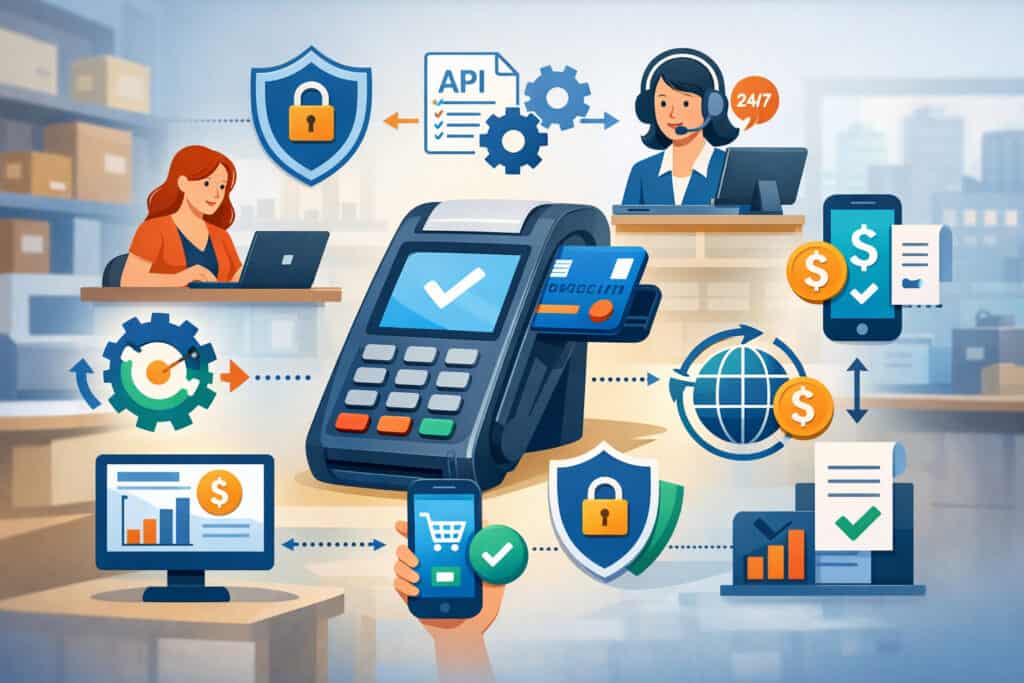
Not every payment provider or software stack is built for the real workflow of an embroidery shop. Some systems are strong for simple retail. Others are better for online selling. A few offer the mix of payment flexibility, reporting, and integration support needed for custom apparel businesses.
When evaluating integrated payment systems for embroidery shops, focus less on flashy feature lists and more on whether the system solves common operational pain points.
Can it support partial payments? Does it make invoice billing easier? Will it keep in-store and online transactions visible in one place? Can your team understand and use it without constant workarounds?
A practical omnichannel setup should help your shop collect payments more easily while also improving the connection between sales, fulfillment, and bookkeeping. The best features are the ones that reduce duplicate work, improve visibility, and support the way customers actually buy from you.
Centralized Reporting, Customer Sync, and Payment Visibility
One of the most valuable features in any omnichannel system is centralized reporting. When payments from online sales, in-store orders, mobile transactions, and invoices can be reviewed together, decision-making becomes much easier.
For embroidery businesses, centralized reporting supports better answers to everyday questions. You can identify which channel drives the most revenue, where outstanding balances are coming from, and whether certain customers consistently reorder through a particular path. It also reduces the time spent pulling reports from multiple dashboards and trying to reconcile totals manually.
Customer sync matters just as much. If one customer orders online, pays in store, and later requests a reorder by invoice, your team should not have to build that history from scratch each time. Stronger unified payment systems for custom apparel shops support shared customer records that make repeat business easier to manage.
Useful capabilities in this area include:
- Shared customer profiles across channels
- Payment history tied to orders
- Visibility into deposits and balances
- Channel-specific sales reporting
- Searchable transaction records
- Sales summaries by location, event, or online source
Invoicing, Saved Payment Methods, and Flexible Checkout Options
Custom embroidery orders often do not fit a standard one-click checkout. Many shops need tools that support deposits, approvals, final invoices, and repeat account billing. That makes invoicing one of the most important parts of payment solutions for custom merchandise businesses.
A strong invoicing feature should let you send secure payment links, track open invoices, apply partial payments, and keep the status visible to staff. For repeat clients, saved payment methods can reduce delays and make reorders faster, especially for buyers who frequently purchase staff uniforms, promotional apparel, or event merchandise.
Flexible checkout options are equally important. Customers may want to pay through:
- A website checkout page
- A secure invoice link
- A countertop terminal
- A mobile card reader
- A manually entered card payment for approved orders
- A stored payment method for repeat billing
The more naturally these methods work together, the stronger your omnichannel setup becomes.
Inventory, Order Tracking, and Software Integrations
Payments should not live in a silo. In embroidery shops, they are closely connected to product availability, job status, and customer communication. That is why software integrations matter so much.
The strongest embroidery business payment solutions often connect to systems such as:
- Inventory tools
- Order management platforms
- Accounting software
- CRM systems
- eCommerce platforms
- POS systems
- Shipping or delivery workflows
When payment status connects to order tracking, your team can more confidently move jobs through production. For example, you can avoid beginning production before a required deposit is received, or quickly confirm that a balance is cleared before releasing an order for pickup.
Inventory integration can also help when your business sells blank apparel, add-on services, or ready-to-buy decorated items across multiple channels. Without syncing, overselling or mismatched records can become a recurring issue.
How Omnichannel Payment Processing Improves Customer Experience and Internal Operations
A good omnichannel setup should make life easier for customers and for your team. The two benefits often go hand in hand. When it becomes easier for customers to pay, it usually becomes easier for staff to track transactions, confirm order status, and move jobs through production with fewer delays.
This matters a lot in embroidery, where orders are often tied to deadlines, customization, and group coordination. A school spirit wear sale, a team uniform reorder, or a corporate apparel project can involve multiple stakeholders, multiple payment moments, and multiple fulfillment steps. When payments are disconnected, those projects become harder to control.
Omnichannel payment processing for embroidery shops supports a more consistent customer journey. Customers can interact with your business in the way that feels most convenient to them while your internal systems stay more organized in the background. That is a major advantage for both service quality and operational efficiency.
A Smoother Buying Experience Across Online, In-Store, and Mobile
Customers do not always think in channels. They think in outcomes. They want to place the order, pay the right amount, and receive the finished items without confusion. If your systems force them to repeat information, wait for manual follow-up, or use inconvenient payment methods, that experience can feel more difficult than it should.
With stronger online and in-store payment solutions for embroidery businesses, the payment process becomes more adaptable. A customer can start online and finish in store.
A repeat client can reorder quickly from an invoice. A parent picking up team hoodies can settle the balance with a tap. A business buyer can approve a deposit from a secure link without a long back-and-forth exchange.
That convenience can lead to:
- Faster approvals and payments
- Fewer abandoned quotes or delayed orders
- Better customer confidence
- More professional communication
- Easier repeat ordering
In custom apparel, those details matter because payment is often one of several steps in a larger service process. The smoother that step is, the smoother the overall experience feels.
Better Reporting, Reconciliation, and Order Coordination
From the internal side, one of the biggest benefits of omnichannel systems is better visibility. When your payment channels are connected, reconciling sales becomes easier and less time-consuming. Instead of comparing spreadsheets, online dashboards, POS reports, and bank records one by one, you can work from a more unified view.
This is especially helpful for embroidery shops dealing with deposits, outstanding balances, and repeat clients. You need to know not just what was sold, but what has been paid, what is still due, and which order that payment belongs to.
Better customer payment options for embroidery shops can also lead to cleaner internal workflows because payments happen more quickly and with less manual intervention. Staff do not have to chase down cards, wait for mailed checks, or manually update multiple systems after each transaction.
Operational improvements often include:
- Faster end-of-day reconciliation
- Fewer duplicate entries
- More reliable order release decisions
- Better matching of payments to jobs
- Clearer sales reporting by channel
- Improved visibility into customer history
More Control Over Deposits, Bulk Orders, and Repeat Client Workflows
Embroidery shops frequently handle orders that do not fit a single-payment retail model. A customer may need to pay a setup fee now, approve a proof later, and pay the final balance at pickup.
A company may submit one large branded apparel order each quarter. A school may run several spirit wear campaigns a year and reorder based on seasonal demand.
These scenarios are where omnichannel merchant services for embroidery shops can create real value. They support payment flexibility without forcing the business into disconnected workarounds.
Deposits, invoices, online payments, counter payments, and saved billing methods can all support a more reliable process when they are connected.
This also improves communication. When staff can see what has already been paid and what is still open, they can give more accurate updates to customers and avoid preventable misunderstandings.
Common Setup Challenges and How to Solve Them
Even though omnichannel systems can improve operations, getting there is not always seamless. Many embroidery shops already have a mix of tools in place, and some of those tools may not communicate well with one another. Others may technically integrate but still leave gaps that create extra manual work.
The goal is not to create a perfect system overnight. It is to identify where payment friction is happening now and solve those issues in a practical order. Most businesses do not need a full technology overhaul on day one. They need a clearer path toward a more connected workflow.
When evaluating payment processing for embroidery shops, it helps to know the most common setup issues ahead of time so you can choose tools and processes that reduce those problems rather than adding new ones.
Disconnected Systems, Duplicate Records, and Manual Reconciliation
One of the most common challenges is fragmentation. The shop may use one system for in-store payments, another for online orders, another for invoicing, and another for accounting. Each tool may work well on its own, but together they create blind spots.
That often leads to duplicate customer records, mismatched transaction histories, and a lot of manual reconciliation. Staff may need to search by name, invoice number, or email address across multiple systems just to confirm whether an order was paid. That wastes time and increases the risk of errors.
A practical fix starts with identifying your primary record of truth. Decide which system should serve as the main reference point for customer orders and payment status. Then choose integrations or workflows that support that model. Even if every detail cannot sync perfectly, your team should know where to look first.
Helpful steps include:
- Standardizing customer naming and contact entry
- Using consistent order numbers across channels
- Reducing the number of tools that process payments independently
- Connecting accounting software to your main payment flow
- Training staff to update one primary system first
Inconsistent Pricing, Staff Confusion, and Hidden Costs
Another challenge appears when pricing and policies are not consistent across channels. A custom add-on may be charged in store but forgotten in invoice workflows. A deposit policy may apply to one sales path but not another. A website may display outdated pricing while the shop uses newer rates at the counter.
This inconsistency creates customer frustration and internal confusion. It can also make reporting less reliable because similar orders may be billed in different ways.
To solve this, align your pricing rules and payment policies across channels as much as possible. That includes:
- Deposit requirements
- Rush fees
- Minimum order policies
- Setup or digitizing fees
- Pickup and delivery payment terms
- Refund or cancellation rules
Hidden costs are another area to watch carefully. Some systems look affordable upfront but become expensive once you add hardware, platform fees, invoice tools, gateway charges, or advanced integrations.
When comparing embroidery shop omnichannel payments options, look at the full operating cost rather than only the headline processing rate.
Adoption Challenges for Small Teams and Growing Shops
Even the right technology can fail if the team does not know how to use it consistently. This is common in small embroidery shops where one or two people manage most operations, or in growing businesses where staff roles are expanding quickly.
If the system feels confusing, employees may fall back on manual workarounds. They may take payments outside the main flow, forget to update invoice status, or skip customer notes that would help later. That weakens the value of the entire omnichannel setup.
A better approach is to keep the workflow realistic. Choose systems your team can actually use every day, and document key processes such as:
- How to take a deposit
- How to send an invoice
- How to apply a final payment
- How to check payment status before release
- How to handle mobile or event transactions
- How to record repeat customer billing preferences
How to Choose the Right Omnichannel Payment Solution for Your Embroidery Shop
Choosing the right system starts with understanding your business model, not chasing a generic “best” platform. An embroidery shop with a retail storefront and daily walk-in traffic has different needs than a home-based custom apparel business that works mostly through invoices and online orders.
A growing multi-channel brand may need deeper integrations and stronger reporting than a smaller shop with lower transaction volume.
That is why the best omnichannel payments for embroidery businesses are the ones that fit your actual order flow, customer mix, and staff capacity. A provider may have strong technology, but if it does not support your common job types or integrate with your key systems, it may create more friction than it removes.
Start by looking at how orders enter your business, how customers prefer to pay, and where your current bottlenecks are. Then evaluate solutions based on their ability to simplify those pain points.
What Small Shops and Home-Based Businesses Should Prioritize
Smaller embroidery businesses often need simplicity, flexibility, and low administrative overhead. Many do not need an enterprise-grade system. They need tools that make it easy to collect payments from multiple channels without paying for complexity they will not use.
For these businesses, strong priorities often include:
- Easy invoice creation and payment links
- Mobile card acceptance
- Online checkout for simple orders
- Basic POS functionality if in-person sales are common
- Clear reporting and simple reconciliation
- Affordable monthly costs
- Easy setup and support
A home-based shop may handle most work through messages, referrals, invoice billing, and occasional events. In that case, mobile payments for embroidery businesses and invoice flexibility may matter more than a large retail feature set. On the other hand, a small storefront may need a stronger POS and pickup workflow from the start.
The key is not choosing a smaller system just because the business is small. It is choosing a system that supports the current workflow while leaving room to grow.
What Growing Retail Locations and Multi-Channel Brands Need
As embroidery businesses grow, payment operations usually become more complicated. There may be more staff, more order volume, more repeat accounts, and more crossover between online and in-person sales. This is where deeper integrations and stronger reporting become more important.
Growing businesses should pay close attention to:
- POS and eCommerce connectivity
- Centralized customer profiles
- Multi-location or event sales tracking
- Inventory sync
- Accounting integrations
- Saved cards and recurring billing for repeat accounts
- More advanced invoice and deposit handling
- Order and payment visibility across staff roles
For these businesses, omnichannel merchant services for embroidery shops should support consistency across channels without slowing down day-to-day operations. The right solution can improve staff coordination, reduce missed payments, and create better visibility into sales patterns.
Questions to Ask Before You Commit
Before choosing a provider or software stack, it helps to ask focused questions tied to real workflow needs. These questions can quickly separate a workable solution from one that only looks good on paper.
Ask things such as:
- Can we accept online, in-store, invoice, and mobile payments within one connected system?
- How are deposits and partial payments tracked?
- Can staff see what has been paid and what is still due by order?
- What customer data syncs across channels?
- Does the POS connect with our online store and invoicing tools?
- What accounting integrations are available?
- Are there extra charges for gateways, hardware, invoices, or advanced reporting?
- How hard is it to train staff on daily use?
These questions matter because payment solutions for custom merchandise businesses need to support customized order flows, not just simple transactions.
Best Practices for Building a Smooth Omnichannel Payment Workflow
Even the best software will not solve every problem on its own. Embroidery shops need a payment workflow that fits how orders move through quoting, approval, production, pickup, delivery, and repeat billing. The strongest systems support that workflow, but the business still needs clear processes behind the technology.
A smooth omnichannel setup should reduce handoffs, prevent missed payments, and make the status of each order easier to understand. It should also feel manageable for your team. If the process becomes too complicated, people will work around it, and the benefits of integration start to fade.
The goal is not just to accept payments in more places. It is to create a connected process where payment collection, order tracking, and customer communication support each other.
Standardize Payment Policies Across Every Channel
One of the best ways to reduce friction is to standardize your payment rules as much as possible. Customers should not get very different terms depending on whether they order online, in person, or through an invoice unless there is a clear reason for it.
This helps create a more consistent brand experience and makes staff training easier. It also reduces misunderstandings around when payment is due and what fees apply.
Areas to standardize include:
- Deposit requirements for custom work
- Final payment timing before pickup or delivery
- Setup and artwork fee policies
- Rush order charges
- Accepted payment methods
- Balance collection procedures
- Terms for repeat or account-based clients
When these policies are aligned across channels, customer payment options for embroidery shops feel flexible without becoming chaotic.
Connect Payments to Real Order Stages
Payment workflows work best when they reflect operational milestones. In embroidery, money collection is often tied directly to design approval, production release, fulfillment, or account terms. If those moments are not built into the workflow, staff may guess or rely on memory.
A stronger process links payments to real stages such as:
- Quote approved
- Deposit paid
- Artwork finalized
- Production started
- Order completed
- Final balance paid
- Pickup or shipment released
This approach helps cross-channel payment processing for apparel stores stay aligned with production. It also gives customers clearer expectations and lowers the chance that completed orders sit waiting because payment status is unclear.
Keep Reporting and Review Simple but Consistent
You do not need an overly complex analytics strategy to benefit from omnichannel reporting. What matters is having a consistent review habit. Even basic weekly or monthly review can uncover useful patterns.
For example, you might track:
- Sales by channel
- Average order value by payment method
- Deposit collection timing
- Open invoices
- Repeat client activity
- Event or pop-up sales performance
- Payment-related delays in fulfillment
This kind of review can help you refine your embroidery business payment solutions over time. You may discover that invoice links speed up approvals, that event sales need better mobile hardware, or that online orders are generating more pickup traffic than expected.
Frequently Asked Questions
Q.1: Can a small embroidery shop benefit from omnichannel payment processing?
Answer: Yes. A small embroidery shop does not need a huge technology stack to benefit from an omnichannel setup. Even a basic connected workflow between invoicing, online checkout, mobile card acceptance, and in-person payments can make a big difference.
The biggest benefits usually come from better payment visibility, easier reconciliation, and more convenient options for customers.
For smaller businesses, the goal is not to add complexity. It is to reduce manual work and make order-based payments easier to track. A simple, well-integrated setup is often more valuable than a larger system with features the shop will never use.
Q.2: What is the difference between omnichannel and regular payment processing?
Answer: Regular payment processing helps you accept payments. Omnichannel processing helps you accept payments across multiple channels while keeping those payment records more connected. That means online, in-store, mobile, and invoice payments are easier to track together rather than being managed separately.
For embroidery shops, that distinction matters because customers often move between channels during one order. A more connected system reduces confusion and helps the business keep payment, customer, and order data aligned.
Q.3: Why are invoice tools so important for embroidery businesses?
Answer: Invoice tools matter because many embroidery jobs do not follow a simple retail checkout path. Shops often need to collect deposits, send balance requests, bill business accounts, and support custom order approvals. Invoicing makes that process easier and more professional.
Good invoice functionality can also support partial payments, payment links, and faster follow-up. For repeat clients such as schools, teams, or branded merchandise buyers, invoicing is often a key part of the overall payment workflow.
Q.4: What features matter most in payment processing for embroidery shops?
The most important features depend on your business model, but many embroidery shops benefit from centralized reporting, invoice links, in-store card acceptance, mobile payments, customer profiles, partial payment tracking, and integrations with eCommerce, accounting, and order systems.
If your shop handles custom orders regularly, focus on features that support deposits, final balance collection, repeat billing, and visibility into what has been paid by order. Those practical functions often matter more than extra features that do not affect daily workflow.
Q.5: Can omnichannel payments help with repeat clients and reorders?
Answer: Absolutely. Repeat clients often buy through different channels over time. They may place one order through email, another through an invoice, and another in person. An omnichannel system makes it easier to keep their payment history, order records, and billing preferences visible.
That can speed up reorders, improve service, and reduce errors. It also makes account-based relationships easier to manage, especially when customers frequently order uniforms, team apparel, or promotional merchandise.
Q.6: Do embroidery shops need both POS and eCommerce integration?
Not every shop needs both right away, but many benefit from having those systems connected. If you sell online and also accept in-store payments or pickups, integration helps keep order and payment records more aligned. It can also improve customer convenience and staff efficiency.
For businesses with both a storefront and an online presence, embroidery POS and eCommerce integration is often one of the most useful parts of an omnichannel payment setup. It helps bridge the gap between where the order started and where it is completed.
Q.7: How do I avoid making my payment workflow too complicated?
Answer: Start with the channels you already use most and fix the biggest points of friction first. You do not need to connect every tool at once. Build around your most common order types, such as custom deposits, invoice billing, online checkout, and pickup payments.
Choose systems your team can actually use consistently. A simpler workflow with strong core integrations is usually better than a complex stack with features that are hard to maintain. The best setup is the one that supports the business without forcing constant workarounds.
Conclusion
Embroidery shops need payment systems that match the way custom orders really happen. Customers may order through your website, message you on social media, call in a reorder, stop by the counter to approve details, or pay from an invoice link after a quote is finalized.
Those actions are all part of the same business, and your payment workflow should support that reality instead of breaking it into disconnected pieces.
That is the real value of omnichannel payment processing for embroidery shops. It helps unify online, in-store, invoice, and mobile payments so the customer experience feels smoother and your internal processes become easier to manage.
It can improve checkout consistency, reduce manual reconciliation, support deposits and bulk orders, and give your team clearer visibility into what has been sold, paid, and fulfilled across every channel.
The best setup is not the most complex one. It is the one that fits your size, sales channels, order types, and customer preferences. A home-based embroidery business may need simple invoices, mobile readers, and online checkout.
A growing storefront may need stronger POS and eCommerce connections. A multi-channel brand may need deeper reporting, customer sync, and repeat billing features.
As you evaluate omnichannel payments for embroidery businesses, focus on practical workflow fit. Look for tools that support real order stages, reduce duplicate work, keep customer and payment records more aligned, and make it easier for people to pay how they prefer.
When your payment system supports the way your embroidery shop actually operates, it does more than process transactions. It helps your entire business run with more clarity, consistency, and confidence.